
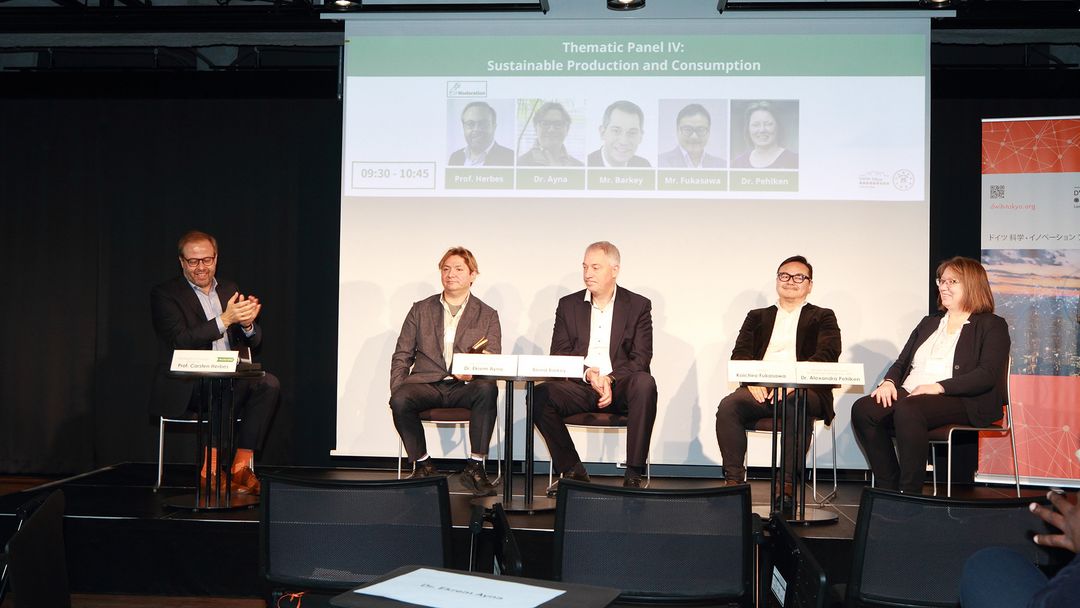
On December 1 and 2, 2025, the international symposium “Sustainable Consumption and Production” took place in Tokyo. The event was organized by the German Centre for Research and Innovation (DWIH Tokyo) and brought together high-level experts from academia, industry, politics, and civil society from Japan, Germany, Taiwan, and Hong Kong. The aim of the symposium was to highlight current research and practical approaches to sustainable consumption and production patterns, identify synergies across disciplines and countries, and deepen international knowledge and experience exchange.
The two-day event focused on interdisciplinary perspectives on the transformation toward a resource-efficient, climate- and environmentally friendly economic system. Keynotes, panel discussions, and poster presentations addressed, among others, the following topics:
- Innovative strategies for sustainable and resilient value chains
- Technological, digital, and social innovations to reduce environmental and resource impacts
- Policy frameworks, governance approaches, and regulatory instruments to promote responsible production and sustainable consumption
- Best-practice examples from industry, research, and civil society initiatives
A particular emphasis was placed on linking technological solutions with societal and institutional transformation processes. It became clear that sustainable consumption and production can only be successfully achieved through the interplay of innovation, regulation, and behavioral change along the entire value chain.
The German Research Center for Artificial Intelligence (DFKI) was represented by Dr.-Ing. Alexandra Pehlken. She moderated a panel on sustainable production systems and contributed her expertise particularly in the areas of life cycle assessment, resource efficiency, and data- and AI-based decision support systems. The discussion highlighted the potential of data-driven approaches to measure, assess, and optimize sustainability impacts in industrial processes.
The symposium was characterized by a broad interdisciplinary and international exchange. Participants and cooperation partners included renowned researchers and practitioners from various sectors, including:
- Prof. Norichika Kanie (Keio University / UN Global Sustainable Development Reports)
- Prof. Carsten Herbes, Prof. Goi Hoe Chin, and Prof. Markus Fischer
- Representatives from politics, ministries, and international organizations
- Stakeholders from industry, start-ups, and civil society initiatives
In the concluding discussion rounds, participants emphasized the need to consistently link technological innovations with social, economic, and cultural aspects. In addition to efficiency gains in production, changes in consumption patterns, new business models, and participatory governance structures were identified as key factors for sustainable transformation.
The event also provided numerous opportunities for networking and for building long-term cooperation between research institutions, companies, and political stakeholders. The goal is to jointly develop viable solutions and anchor sustainable action as an integral part of future research, innovation, and transformation processes.
Through its in-depth expert discussions and international exchange, the DWIH Tokyo Symposium made an important contribution to positioning sustainable consumption and production patterns as a central element of transdisciplinary research and innovation agendas at the global level.