
Green AI Hub Forum 2025: Sustainable Business with AI
| Environment & Energy | Marine Perception | Smart Enterprise Engineering | Berlin | Osnabrück / Oldenburg
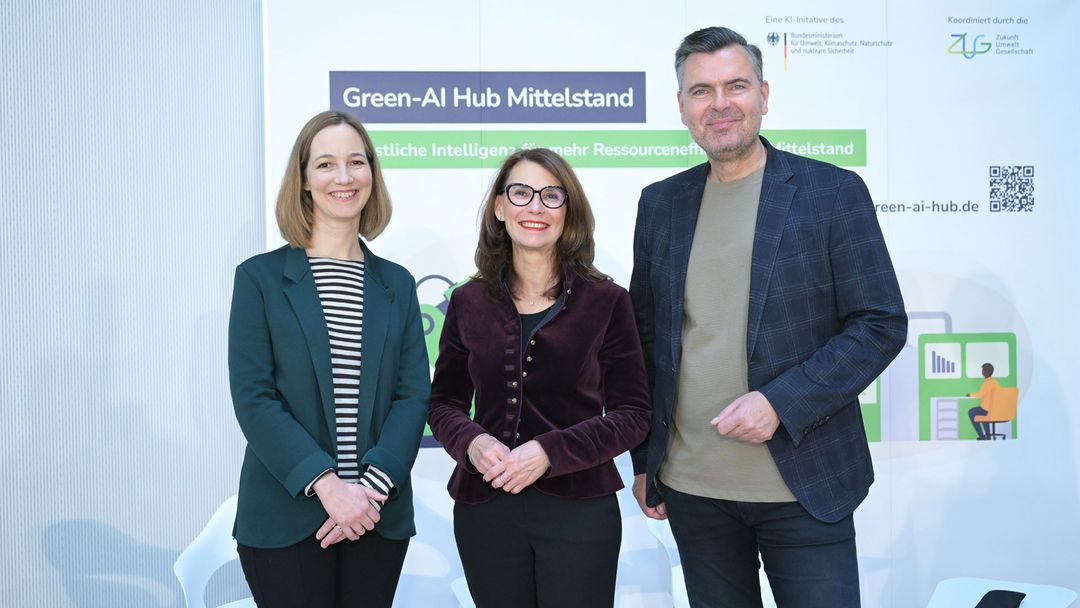
The event was opened with welcome addresses by Rita Schwarzelühr-Sutter (Parliamentary State Secretary at the Federal Ministry for the Environment, Climate Action, Nature Conservation and Nuclear Safety, BMUKN) and Dr. Constanze Haug (Managing Director of ZUG gGmbH). They emphasized that AI represents a powerful lever for increasing resource efficiency and promoting a sustainable circular economy in SMEs. The Green AI Hub SME initiative was highlighted as a key bridge between medium-sized businesses, research, and sustainability policy.
Prof. Dr. Oliver Thomas, Project Lead of the Green AI Hub SME initiative at DFKI, also underlined the importance of application-oriented AI solutions in his contribution: with such solutions, SMEs can implement sustainable value creation in a concrete and measurable way.
Practical Examples Demonstrate Measurable Sustainability Impacts
Several presentations and practical case studies made it clear that AI is by no means a vision of the future, but already delivers tangible benefits today:
- An industrial company demonstrated how AI-based control systems help optimize energy consumption and make production processes more environmentally friendly.
- In the manufacturing sector, AI-supported process optimization was shown to reduce material usage—without compromising quality or productivity.
- A medium-sized company specializing in turning technology reported that AI-based analyses of machine data help reduce scrap, improve maintenance planning, and use resources more efficiently.
These examples show that AI in SMEs is not abstract—it delivers measurable impacts in terms of environmental performance, efficiency, and economic viability.
Results from Pilot Projects
Since 2023, the Green AI Hub SME initiative has supported numerous pilot projects with SMEs. Evaluations show that AI applications in both production and services can generate not only economic but also ecological improvements.
- Since 2023, the Green AI Hub SME initiative has supported a total of 20 AI pilot projects—14 in the manufacturing sector and 6 in IT and services.
- According to a newly published background paper, pilot projects in manufacturing reduced the material footprint by up to 15% and the carbon footprint by up to 16%, demonstrating significant environmental effects.
- Many companies are already planning follow-up or expansion projects—AI is increasingly understood as a strategic tool rather than a one-off measure.
- If scaled, the approaches show an annual savings potential of up to 6,250 tonnes in material footprint and approximately 1,300 tonnes of CO₂ equivalents.
The published background paper documents methodological approaches, savings potential, and success factors, providing other companies with well-founded guidance on how to use AI sustainably.
Conclusion
The forum, the background paper, and the pilot projects deliver not only technical evidence, but also practical guidelines and hands-on experience for SMEs aiming to implement AI sustainably. The Green AI Hub Forum 2025 demonstrated that AI and sustainability are not contradictions—on the contrary: with smart application, supportive policy frameworks, and practice-oriented guidance, AI can make a significant contribution in SMEs to combining resource efficiency, circular economy, and climate protection. The experience from the pilot projects clearly shows: AI works—real, measurable, and scalable.
Weitere Informationen:
Contact:
Sina Born, MBA
DFKI Osnabrück
Johannes Solzbacher, M.Sc.
DFKI Osnabrück
- Johannes.Solzbacher@dfki.de
- Phone: +49 541 386050 4880
Press contact:
Maria Santos, M.A.
Communications & Media, DFKI Oldenburg
- Maria.Santos@dfki.de
- Phone: +49 441 99833 6620