
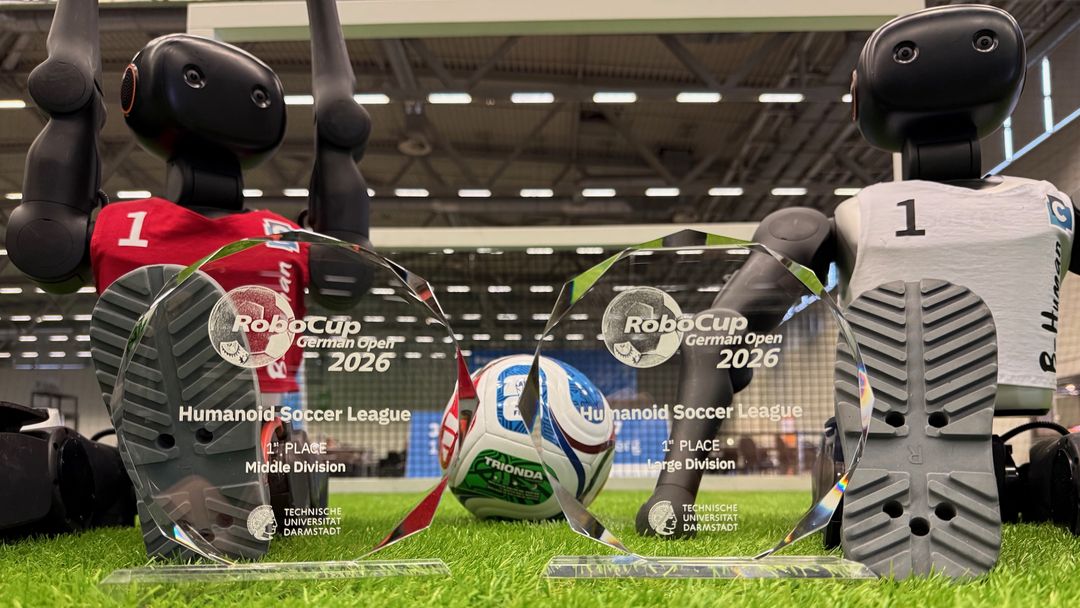
The twelve-time world champion B-Human has long been a dominant force in the RoboCup Standard Platform League, which has now been merged with the Humanoid League to form the new Humanoid Soccer League. For the first time, B-Human competed with a new robot platform: the humanoid Booster K1 from Booster Robotics.
The Humanoid Soccer League is divided into three divisions – Small, Middle, and Large – each defined by the maximum size and weight of the robots. Robots that are smaller or lighter than the division limits are allowed to compete in that division, while larger robots are not permitted to play in smaller divisions. At the German Open, B-Human participated in both the Middle and Large Divisions. A key difference between the divisions is the ball size: a standard football (FIFA Size 5) is used in the Large Division, while a slightly smaller ball (FIFA Size 3 or 4) is used in the Middle Division.
In the Middle Division, the Bremen team won all seven of their matches convincingly. Both in the preliminary round and the semifinals, B-Human secured wins with a 10-goal margin. In the final, the team faced the HTWK Robots from the Leipzig University of Applied Sciences (HTWK Leipzig), who also played with Booster K1 robots and had won the world championship in the Kid Size Humanoid League last year. B-Human achieved a decisive 6:1 victory.
In the Large Division, the team initially had a mixed start: besides a win and a draw, they lost once to the HTWK Robots, who also competed in both divisions. In the final, however, B-Human delivered a significantly improved performance and secured a clear 4:1 victory, taking the championship.
With their double victory in Cologne, B-Human now sets its sights on the RoboCup World Championship 2026, taking place from June 30 to July 6 in Incheon, South Korea.
About B-Human
B-Human is a joint project of the University of Bremen and the DFKI research department Cyber-Physical Systems, led by Prof. Dr. Rolf Drechsler. With numerous national and international titles, the team ranks among the most successful in the history of the RoboCup.
The team in Cologne consisted of eight students from the University of Bremen and one doctoral candidate. It is scientifically supervised by Dr. Thomas Röfer (DFKI Cyber-Physical Systems) and Dr. Tim Laue (Multisensory Interactive Systems Research Group, University of Bremen).
Since 2017, the main sponsor has been CONTACT Software, a leading provider of solutions for product processes and digital transformation. Additional supporters include JUST ADD AI, cellumation, Ubica Robotics, and Alumni of the University of Bremen e.V.


