
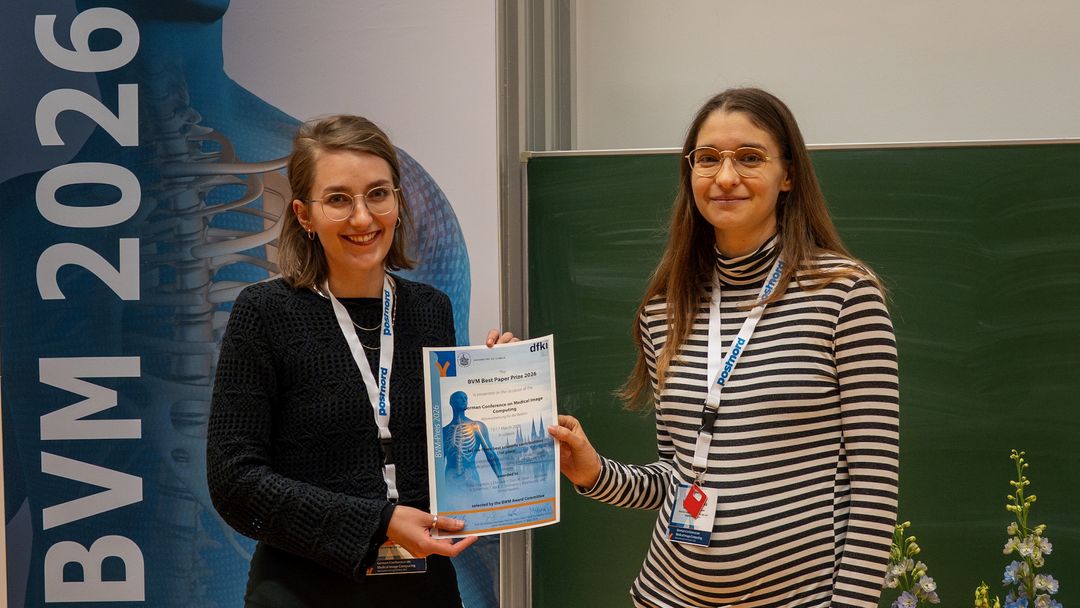
In her paper, she and researchers from the DFKI, the University of Lübeck, and the University Hospital Schleswig-Holstein, present an interpretable approach to the automated classification of lymph node stations (LNS) and N-staging using PET/CT and CT images. The authors present an approach that extends two established segmentation algorithms with probabilistic atlas-based LNS mapping and rule-based N-staging to enable automated LNS classification and N-staging on PET/CT and CT images. N-staging is part of the widely used TNM cancer classification system, whereby the N-stage indicates the extent of metastatic spread to regional lymph nodes. However, N-staging is a multi-step process that is error-prone and labour-intensive. Related work often covers only subtasks of N-staging, requires manual annotation to generate input, or uses inferior reference standards to generate ground truth.
The full automation of the N-staging pipeline, with verifiable results at every processing step, as presented in the paper, could enhance the efficiency of clinical practice and improve and standardise manual N-staging. The authors’s results demonstrate that a probabilistic approach strongly improves LNS mapping in comparison to label fusion via majority voting. The proposed method achieves an accuracy of 0.74 for LNS classification and 0.68 for N-staging on PET/CT. This represents a significant improvement towards human-level performance compared to the baseline approach.
The developed algorithm could serve as a decision support tool. As trust is crucial for users in the healthcare sector, the ability to verify intermediate results and processing steps is a key strength of this research.
The awarded paper:
Sofija Engelson, Jan Ehrhardt, Yannic Elser, Malte M. Sieren, Julia Andresen, Stefanie Schierholz, Tobias Keck, Daniel Drömann, Jörg Barkhausen und Heinz Handels (2026). Interpretable Mediastinal Lymph Node Station Classification and N-staging on CT and PET/CT Images. In: Handels, H., et al. Bildverarbeitung für die Medizin 2026. BVM 2026. Informatik aktuell. Springer Vieweg, Wiesbaden. DOI: 10.1007/978-3-658-51100-5_1
Link: https://link.springer.com/chapter/10.1007/978-3-658-51100-5_1#citeas