
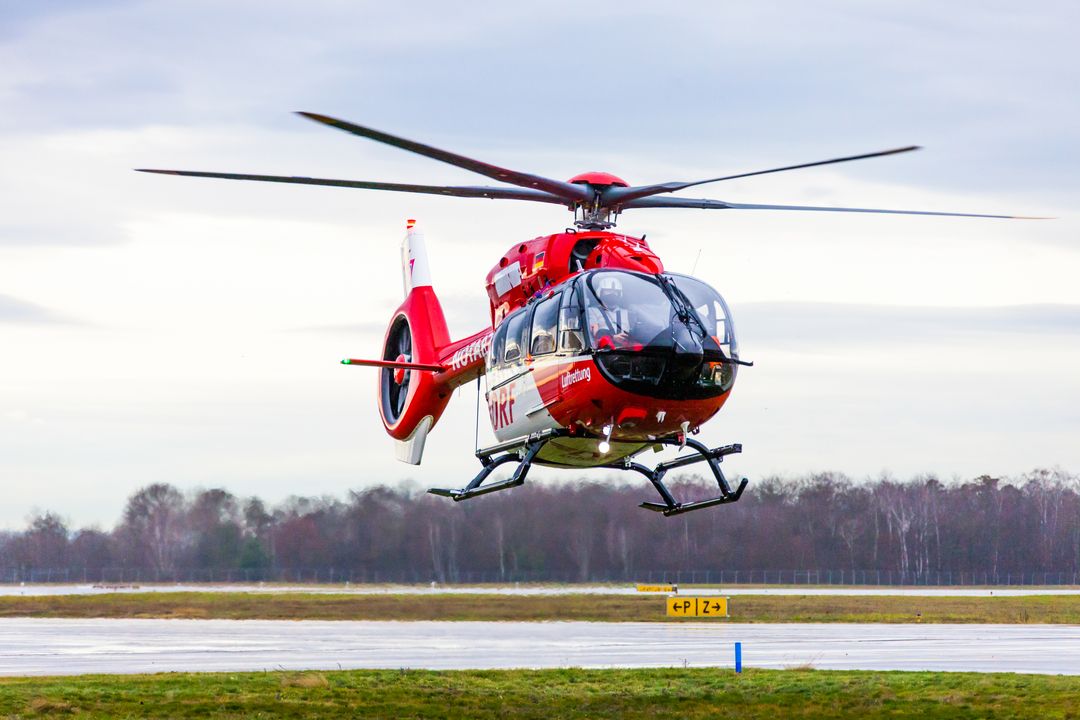
- AI-powered decision support for Public Safety Answering Points (PSAPs): PRIORITAS
- Holistic consideration of the entire emergency care pathway, from the emergency call to hospital admission
- Real-time data supports the dispatch of Emergency Medical Services (EMS) resources
- DFKI is developing the project's AI methods and analytical framework
- DRF Luftrettung is contributing as an operational partner to the development process
Strategic air rescue dispatching in PSAPs using Artificial Intelligence
In time-critical emergencies, dispatchers at PSAPs must make rapid decisions that can be crucial for patient survival and subsequent recovery. Drawing on information available and obtained during the emergency call, dispatchers assess the patient's condition and determine EMS resources required. Beyond resource availability, the capacity of appropriate receiving hospitals is another key factor in the dispatch process. If an air rescue resource is considered, weather conditions may further influence whether and how the mission can be carried out. The sheer number of factors involved makes emergency dispatch a highly complex task. This is where PRIORITAS makes a difference: An innovative AI project, funded by the DRF Stiftung, that aims to sustainably enhance dispatch decision-making in PSAPs.
Applied research expertise for the benefit of patients
Existing systems have only limited capacity to adapt to dynamic operational circumstances. Instead, they primarily focus on minimizing response time and rely on static dispatch protocols. Under the leadership of the German Research Center for Artificial Intelligence (DFKI), a novel AI-powered analysis and decision-support system is being developed that, for the first time, takes a holistic view of the entire emergency care pathway and a wide range of relevant parameters. From the initial emergency call to patient handover at the appropriate hospital, PRIORITAS combines all mission-critical information into a clear and comprehensive digital operational picture. Dynamically changing factors - such as EMS resource availability, hospital capacity, and real-time weather data - are continuously considered and can be seamlessly integrated into existing computer-aided dispatch systems. Based on this information, dispatchers receive transparent and explainable suggestions that support and guide, rather than replace, their expertise. The goal is to reduce cognitive workload while improving confidence in decision-making and the quality of decisions at the same time.
Smarter processes, better care: benefits across the EMS ecosystem
The approach developed within PRIORITAS is expected to benefit a wide range of stakeholders across healthcare and EMS: For patients, optimized coordination of emergency responses means shorter prehospital times and improved quality of care. Emergency response staff benefits from more stable mission executions due to fewer follow-up dispatches. PSAPs gain a clearer overview of available resources and can make more consistent and profound decisions. Health insurers and other payers also benefit from more efficient processes that can help reduce transport and treatment costs. Overall, PRIORITAS contributes to a more efficient, targeted, and higher-quality emergency care system.
Backed by more than 50 years of air rescue expertise and a strong professional network
Drawing on its extensive operational experience and professional network, DRF Luftrettung is closely involved in the development process, helping to ensure that the system is not only technically advanced but also delivers tangible benefits in day-to-day operations. Emphasis is placed on the responsible use of artificial intelligence. The goal is to develop a solution that is transparent, explainable, and practical for real-world use, thereby fostering trust and acceptance among dispatchers in PSAPs. Throughout the project, the partners will work with selected PSAPs in Baden-Württemberg to establish and define the prerequisites and framework conditions for piloting PRIORITAS. The pilot phase will provide valuable insights that will be incorporated into the further development of the system. Feedback from real-world emergency dispatch operations will help refine the system step by step and ensure that it remains closely aligned with the practical requirements of everyday use. A key advantage of PRIORITAS: the development of an innovative adaptive emergency call-handling protocol as an open-source project. It will remain open, transparent, and capable of being further developed by a wider range of stakeholders. This openness provides an important foundation for long-term, nationwide adoption and integration.
Project kick-off on April 8, 2026, sends a strong signal
The kick-off meeting held in early April at the DRF Luftrettung Operations Center in Rheinmünster highlighted a key success factor for PRIORITAS: close collaboration between partners from research, air rescue, PSAP operations, and technology development. The participating organizations contribute not only their specialist expertise but also valuable insights from their respective professional networks, ensuring that diverse perspectives from across emergency care are incorporated into the project from the outset. The overarching objective of PRIORITAS is clear: to help ensure that people in emergency situations receive the right assistance more quickly, safely, and appropriately. We are convinced that the project will make an important contribution to improving patient care and saving lives, while supporting the efficient use of valuable EMS resources – both today and in the future.
About DRF Luftrettung
DRF Luftrettung, headquartered in Filderstadt, is one of the largest air rescue organizations in Europe. From 34 stations at 32 locations across Germany, the non-profit organization deploys its helicopters and fixed-wing air ambulances on a wide range of missions. These include emergency medical missions, interhospital transfers of critically ill or injured patients, and repatriation missions from abroad. At 13 of its helicopter stations, crews are ready for deployment around the clock; at one additional station, the crew is available during daytime operations with extended operating hours. Helicopters equipped with rescue hoists are operated at five locations. In total, DRF Luftrettung completed 36,407 missions in 2025. To continuously expand its lifesaving mission, the non-profit air rescue organization relies on financial support. DRF e.V. already has around 400,000 supporting members by its side.
About the DRF Stiftung
As a funding body, the DRF Stiftung is committed to improving emergency assistance and emergency medicine, particularly using aircraft. As a foundation under civil law, it supports specific project initiatives that bring about lasting positive change in emergency care. More information is available at www.drf-stiftung.de