
AI for Waterway Maintenance and Operational Planning: Research from Lower Saxony with International Visibility
| Environment & Energy | Human-Machine Interaction | Sensors & Networks | Awards | Marine Perception | Osnabrück / Oldenburg
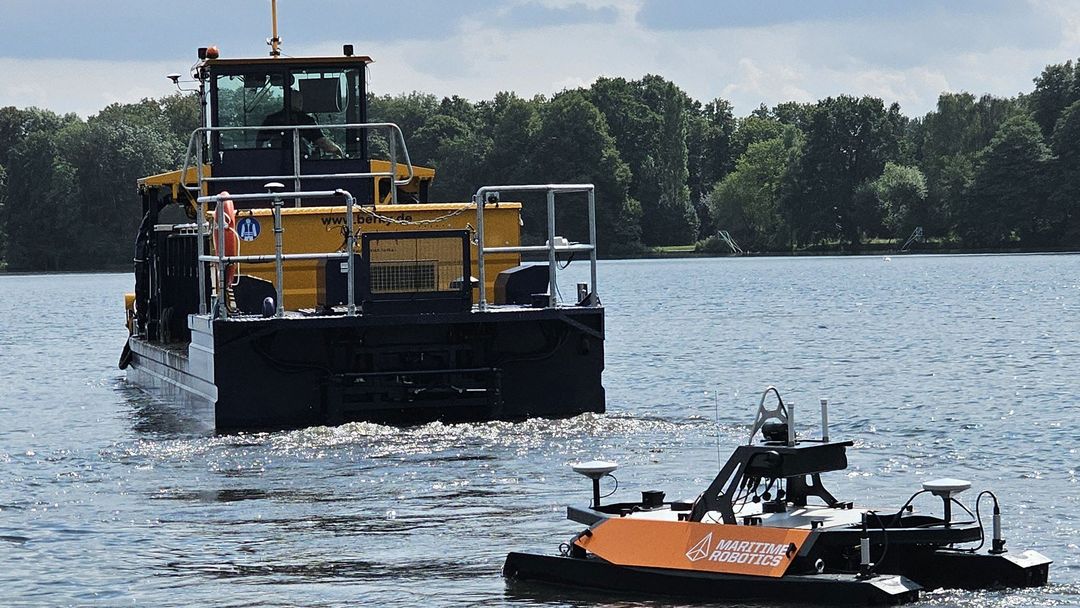
Development takes place on two levels:
In a laboratory-based setting, sensors, algorithms, and design concepts are tested and refined under controlled conditions. In addition, the systems are evaluated on a specialized vehicle used for data collection, field testing, and validation under real-world conditions, for example in the context of waterway and inland water maintenance.
From Research to Application
At the core of the project is the development of hybrid AI methods that systematically combine different approaches, such as data-driven learning models and knowledge-based components. While such systems can support complex decision-making processes, they also place high demands on transparency and interpretability.
HAI-x therefore integrates explanation mechanisms not as an add-on feature, but as a structural component of the overall system architecture. One developed approach combines explanations from different AI subsystems into coherent overall explanations, thereby establishing the foundation for trustworthy decision support in practical deployment.
Although development is based on a specific application scenario, the technology is intentionally designed to be transferable. Potential application areas range from waterway and inland water maintenance to operational planning and logistical coordination, for example in waste management or infrastructure services.
Regional Anchoring, International Recognition
Part of the research activities is carried out in Hanover, including work conducted in the vicinity of Lake Maschsee. In this way, the project combines regional anchoring in Lower Saxony with scientific excellence and international visibility.
The architectural approaches for explainable hybrid AI developed within the project have also attracted international attention. A key methodological contribution was awarded the Best Technical Paper Award at AI-2023 – 43rd SGAI International Conference on Artificial Intelligence in Cambridge. The project was also represented at AI-2025 – 45th SGAI International Conference on Artificial Intelligence, contributing its research findings to the scientific discourse.

“With HAI-x, we are developing AI systems that are not only high-performing but also make their decisions comprehensible. We rely on hybrid AI systems, intelligent solutions that combine different AI methods to achieve robust and reliable results. The combination of national research, practical application, and international visibility demonstrates how AI innovations from Germany can generate impact beyond national borders.”
Contact:
Prof. Dr. Frederic Theodor Stahl
- Frederic_Theodor.Stahl@dfki.de
- Phone: +49 441 99833 4713