
Städte im Klimasturm: Wie KI den Blindflug beendet
| Umwelt & Energie | Data Management & Analysis | Sensorik & Netzwerke | Smarte Daten & Wissensdienste
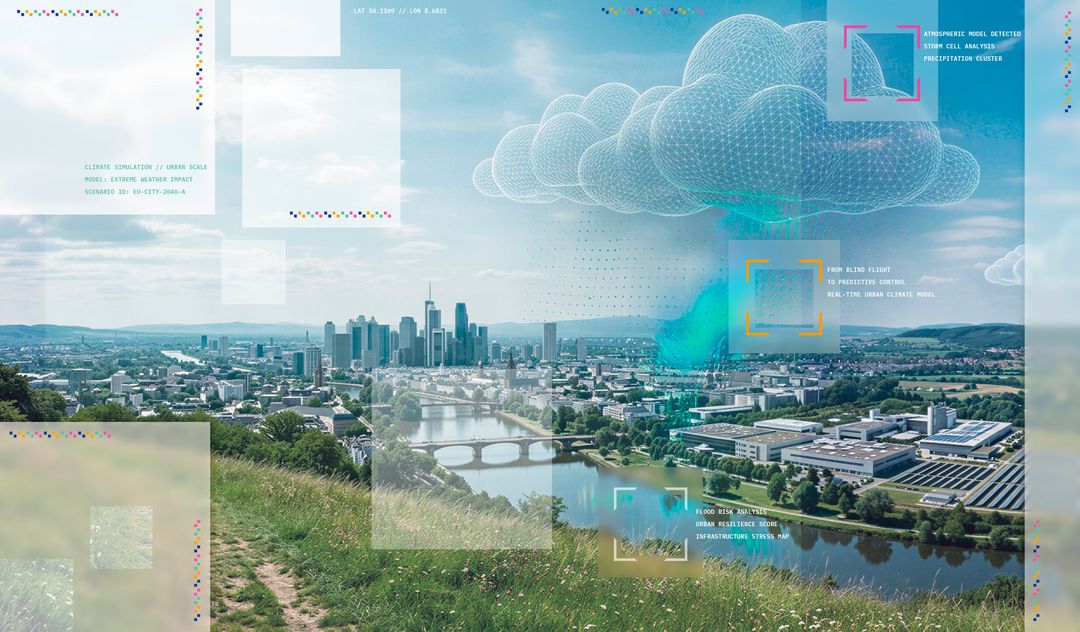
Water management has made great strides in digitalisation and automation in recent years. Sensors record water levels, models forecast discharges – everything works perfectly as long as conditions remain normal. However, historical data rarely reflects extreme events such as heavy rainfall. Measurement campaigns are costly, and the results are often not publicly available. Local authorities are thus navigating growing climate risks in the dark – and bearing the consequences.
Generative AI models solve this data puzzle. They learn real-world distributions and generate synthetic time series that plausibly represent even rare extremes. Research findings show that such data significantly improves the accuracy of forecasting models. Some even achieve the quality of real measurement series using exclusively AI-generated data. For cities, this means more reliable provision.
DFKI research under Prof. Dengel: Practice over theory
At the DFKI in Kaiserslautern, Prof. Andreas Dengel, as Managing Director and Head of the ‘Smart Data & Knowledge Services’ division, is driving these approaches forward in collaboration with the other research divisions based there. For example, researchers are testing AI systems directly on the city’s wastewater network and establishing partnerships with federal institutions.

This not only improves hydrology and water quality, but also provides policymakers and administrators with concrete options for action.
Hinter den Kulissen: Wie das KI-Modell funktioniert
Der am DFKI entwickelte Ansatz transformiert die Art und Weise, wie Kanalhydraulik betrachtet wird: Weg von der rein statischen Planung, hin zur dynamischen, datengetriebenen Prognose. Das Modell nutzt Zeitreihen von Niederschlag und gemessenen Wasserständen, um zu lernen, wie sich Wasser in urbanen Systemen unter wechselnden Wetterbedingungen ansammelt und ausbreitet.
Vom „Blindflug“ zur präzisen Vorhersage
Im Gegensatz zu klassischen hydrodynamischen Modellen, die auf der aufwendigen Lösung komplexer physikalischer Gleichungen basieren, lernt diese KI die Systemdynamik direkt aus historischen Beobachtungen. Ein entscheidender Hebel ist dabei der Einsatz generativer Modelle: Sie erzeugen synthetische Trainingsdaten, die insbesondere seltene Extremereignisse wie Starkregen – die in realen Messdaten oft unterrepräsentiert sind – plausibel abbilden. Diese Datenaugmentation schließt die gefährliche Lücke zwischen Durchschnittswerten und realen Wetterrisiken.
Integration und Ausblick
Das System ist konzeptionell als ergänzende Schicht in bestehende Analyse- und Planungsworkflows konzipiert. Es dient als Prognosekomponente, die bestehende Simulationsmodelle nicht ersetzt, sondern entscheidend präzisiert. Der aktuelle, auf realen Messdaten aus Kaiserslautern validierte Forschungsprototyp demonstriert bereits eindrucksvoll das Potenzial: Eine Vorhersage von Wasserständen im Kanalnetz für die kommende Stunde ermöglicht Kommunen, schneller auf sich zuspitzende Lagen zu reagieren. Die Technologie liefert damit eine belastbare Grundlage für Frühwarnsysteme, die strategische Infrastrukturplanung und den Katastrophenschutz.
From technology to responsible policy
AI does not replace engineers, but it does make up for missing data. It makes digital twins more resilient to climate stress. The real question is a political one: should cities learn reactively from damage – or plan proactively using simulated scenarios? Synthetic data better equips local authorities, even on tight budgets. In the face of climate change, this is not an option, but a duty.
Contact:
Prof. Dr. Prof. h.c. Andreas Dengel
Geschäftsführender Direktor, DFKI Kaiserslautern
- Andreas.Dengel@dfki.de
- Phone: +49 631 20575 1000
Prof. Dr.-Ing. Ulrich Dittmer
Leitung Wasser Infrastruktur Ressourcen, Fachbereich Bauingenieurswesen | RPTU
- ulrich.dittmer@rptu.de
- Phone: +49 631 205-2946
Press contact:
Jeremy Gob
Wissenschaftlicher Redakteur & Referent für Öffentlichkeitsarbeit, DFKI Kaiserslautern
- Jeremy.Gob@dfki.de
- Phone: +49 631 20575 1730
Further information:
- Water depth prediction in combined sewer networks, application of generative adversarial networks
In der Fachpublikation „Water depth prediction in combined sewer networks, application of generative adversarial networks“ (Discover Applied Sciences, 2024) stellen die DFKI-Forschenden gemeinsam mit Ihren Partnern an der RPTU die methodischen Grundlagen des Projekts vor.