Antimicrobial resistance is one of the most pressing health threats of our time: an estimated 4.7 million deaths per year are already linked to antibiotic resistance, and this number could more than double by 2050.
The development of new antibiotics fails disproportionately often due to a lack of selectivity: promising drug candidates damage human cells alongside bacteria (cytotoxicity) and are consequently discarded only in late, cost-intensive stages of development. The collaborative project OptimAIze addresses precisely this bottleneck, tightly integrating predictive, explainable and generative AI methods with high-resolution experimental data to reliably distinguish efficacy from cytotoxicity in antibiotic candidates at an early research stage.
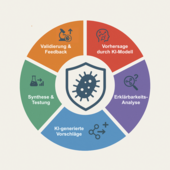
At the core of the project is an iterative AI-experiment cycle following the Design–Make–Test–Analyze (DMTA) principle. A novel single-cell cytotoxicity platform in 384-well high-throughput format delivers time- and mechanism-resolved toxicity profiles, distinguishing apoptosis, necrosis and proliferation inhibition at the single-cell level. This data, together with public databases and exclusive compound libraries from the industry partners, feeds hybrid AI models — including graph neural networks and transformer-based chemical language models — that predict the activity, cytotoxicity and ADME properties of new molecules.
Using explainable AI (XAI) and pattern-mining methods, DFKI identifies critical molecular substructures that drive efficacy or toxicity. These mechanistic insights in turn guide generative AI models that propose targeted molecular modifications; the resulting candidates are synthesized, biologically validated, and the results are fed back into continuous model refinement.
DFKI coordinates the project through its Neuro-Mechanistic Modeling research area (Prof. Dr. Verena Wolf, Saarbrücken) and, alongside project management, leads the work package on explainable AI. Project partners are Saarland University (Volkamer, Klakow and Hoth research groups), the Helmholtz Institute for Pharmaceutical Research Saarland (HIPS, Prof. Anna K. H. Hirsch), and smartbax GmbH (Dr. Robert Macsics), which contributes proprietary data from a high-throughput screen of 145,000 compounds against the antibacterial target protein SpsB.
By the end of the 36-month project, validated drug candidates with a significantly improved efficacy-toxicity profile are expected. OptimAIze is funded by the Federal Ministry of Research, Technology and Space (BMFTR) under the funding guideline "Application of Artificial Intelligence in Drug Discovery."
Partners
Deutsches Forschungszentrum für Künstliche Intelligenz, DFKI (Prof. V. Wolf) Universität des Saarlandes (Prof. A. Volkamer, Prof. D. Klakow, Prof. M. Hoth) Helmholtz-Institut für Pharmazeutische Forschung Saarland, HIPS (Prof. A. K. H. Hirsch) smartbax GmbH, Leopoldstraße 37, 80802 München (Dr. Robert Macsics)
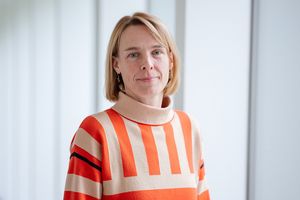 Prof. Dr. Verena Wolf