
OptimAIze: AI Aims to Accelerate the Development of New Antibiotics to Combat Drug-Resistant Bacteria
| Health & Medicine | Data Management & Analysis | Neuro-mechanistic Modeling | Saarbrücken | Press release
Every year, millions of deaths worldwide are linked to antibiotic resistance. At the same time, developing new antibiotics is particularly risky, as many drug candidates are eliminated in early development phases due to undesirable side effects or lack of efficacy.
OptimAIze addresses the urgent medical need for new antibiotics and the specific development challenges posed by antimicrobial resistance and high preclinical failure rates, often caused by an unfavorable balance between efficacy and toxicity. The goal is to develop and apply generative AI methods to target the modification of drug candidates to increase their efficacy and reduce cytotoxicity—that is, the potential damage to human cells. A particularly innovative aspect is the integration of mechanistic knowledge into the AI.

“Artificial intelligence opens up enormous opportunities for drug discovery. At the same time, purely data-driven models reach their limits, especially when only limited or unbalanced data is available. That is why, in OptimAIze, we rely on a combination of AI and mechanistic expertise. This allows us not only to make more precise predictions but also to better understand why certain molecules are effective or toxic."
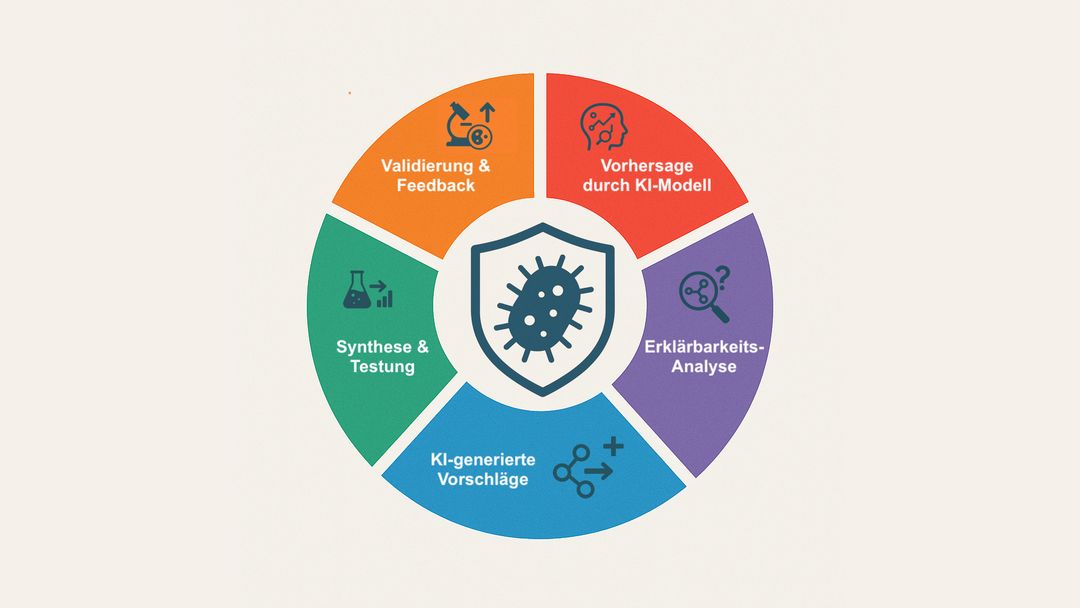
At the heart of the project is a novel closed-loop learning cycle that combines artificial intelligence and experimental validation. High-resolution cytotoxicity data are analyzed using modern AI methods. In the process, the models not only learn to predict the efficacy and tolerability of molecules but can also specifically suggest new drug candidates, which are then tested experimentally. The results are fed back into the AI models, continuously improving their predictive power.
The added value of OptimAIze lies in its integrated AI optimization, which combines knowledge across AI and computational chemistry to efficiently propose molecules with improved antibiotic activity and lower toxicity that can be synthesized and tested immediately.
To this end, the consortium brings together complementary expertise: DFKI develops methods for explainable and generative AI; Saarland University contributes expertise in drug design, language models, and single-cell analyses; HIPS handles the chemical synthesis and optimization of the candidates; and smartbax GmbH provides exclusive data and drug programs from industrial antibiotic research.
In addition to developing specific antibiotic candidates, OptimAIze also aims to make innovative AI methods and software tools available to the scientific community. The algorithms developed will be published as open source—as far as possible—and will thus support further research projects in the long term in the fight against antibiotic resistance.
With a duration of three years, OptimAIze aims to set new standards for AI-supported drug discovery and make a significant contribution to combating antimicrobial resistance. The project is funded by the Federal Ministry of Research, Technology, and Space under the funding guideline “Application of Artificial Intelligence in Drug Discovery.”
Project Partners:
Contact:
Prof. Dr. Verena Wolf
Head of Neuro-Mechanistic Modeling Research Department, DFKI
- Verena.Wolf@dfki.de
- Phone: +49 681 85775 5586
Press contact:
Heike Leonhard, M.A.
Communications & Media, DFKI Saarbrücken
- Heike.Leonhard@dfki.de
- Phone: +49 681 85775 5390