
AI for Machine Tools: VDW Research Institute Honors DFKI Researcher
| Industry 4.0 | Awards | Marine Perception | Osnabrück / Oldenburg
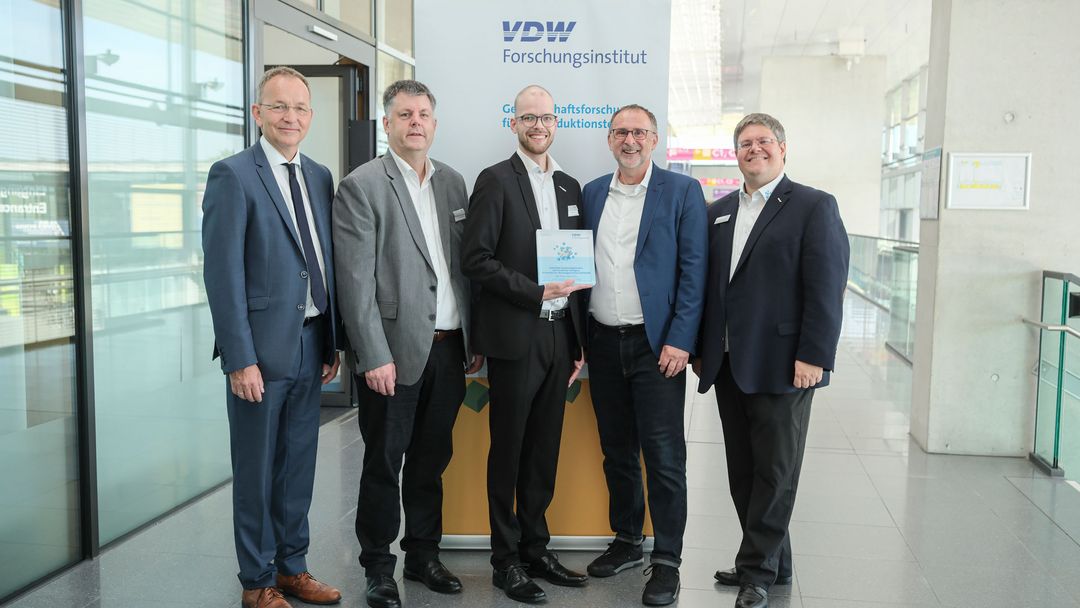
Commissioned by the research institute of the German Machine Tool Builders’ Association (VDW), DFKI worked together with the VDWFI working group “Control and Systems Technology” to investigate where the use of AI could provide tangible benefits for companies in the machine tool industry. The aim of KI4WZM was to identify relevant challenges from industrial practice, examine existing research and solution approaches, and use these findings to develop potential approaches for future research and development projects.
As a first step, challenges and requirements were identified and prioritized together with VDW members. Based on these findings, Rodenbäck examined existing approaches from research and industrial practice. The topics included knowledge management, support for fault diagnosis, process parameter optimization, and optical collision avoidance.
Concrete Project Ideas for the Use of AI
The research resulted in concrete project ideas for potential AI applications in the machine tool industry. One of these is multimodal diagnostic support: control system alarms could be combined with log files, runtime data, and machine documentation to identify the causes of faults more quickly and provide recommendations for action.
Another approach involves the data-driven optimization of process parameters such as rotational speed, feed rate, or depth of cut, taking into account the material, tool, process data, and quality targets.
Knowledge management also played an important role. One project idea developed as part of KI4WZM is the automated documentation of software code. Existing codebases could be analyzed using AI and compared with existing documentation. The aim is to reduce the amount of manual documentation required, keep code and documentation up to date and consistent, and thereby help prevent errors.
The research also showed that large, computationally intensive AI models are not necessary for every task. Depending on the application, smaller models that can be run locally may offer an alternative – particularly when data needs to be processed directly within the company.

“AI offers great potential for the machine tool industry – but not every challenge requires a highly complex model. The key is to focus on areas where companies have a concrete need and suitable data is available. For us, this connection between technological possibilities and practical requirements was particularly important in KI4WZM”.
Transferring Results into Practice
The results of KI4WZM were compiled in a comprehensive report. Following the completion of the project, a workshop with around 60 participants was held. The workshop presented the findings to a broader audience within the VDW community and provided an opportunity to collect, develop, and prioritize further project ideas.
In addition to identifying potential fields of application, KI4WZM also highlighted the conditions that are essential for the meaningful use of AI. These include, in particular, the availability and quality of suitable data as well as aspects such as reliability, explainability, and local data processing.
Eike Rodenbäck has been a researcher at DFKI Niedersachsen since October 2024. His research focuses include resource-efficient AI methods that can be run locally as well as the analysis of image and sensor data.
Contact:
Eike Rodenbäck, M.Sc.
- Eike.Rodenbaeck@dfki.de
- Phone: +49 441 99833 4754