
AI Week 2026: DFKI’s Lübeck Laboratory shows how AI can benefit healthcare, caregiving and everyday life
| Health & Medicine | Data Management & Analysis | Image Recognition & Understanding | Human-Machine Interaction | Robotics | AI for Assistive Health Technologies | AI in Medical Image and Signal Processing
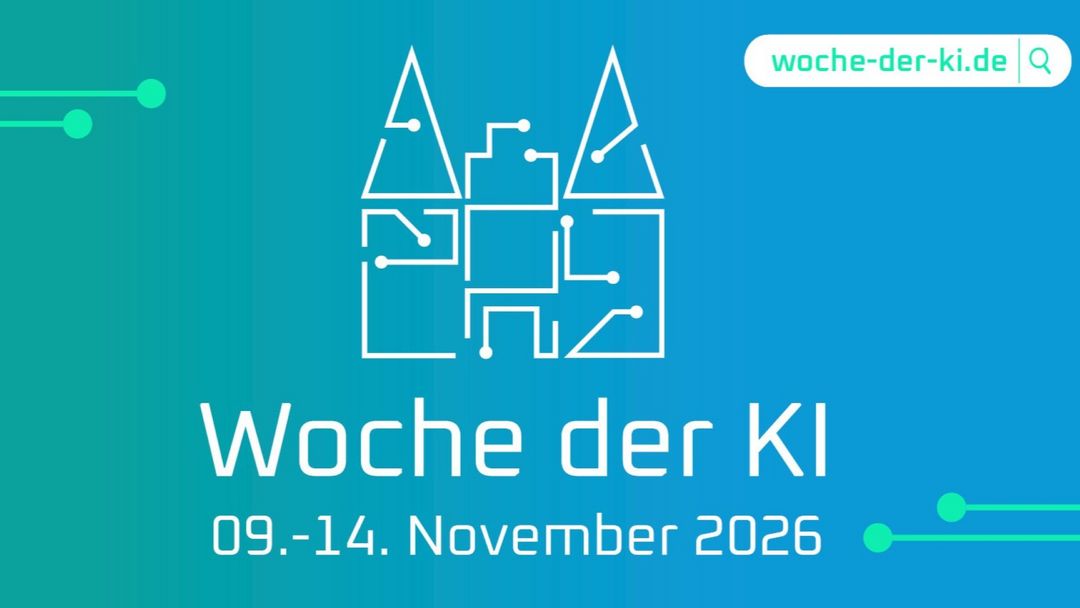
The week-long event is organised by the University of Lübeck, Lübeck University of Applied Sciences, the DFKI and the Lübeck Chamber of Industry and Commerce, in collaboration with the associated partner Fraunhofer IMTE.
The programme is aimed at a variety of target groups: it includes hands-on activities for anyone interested, talks and workshops on various fields of application for AI, as well as formats for discussion and collaborative development. Highlights include the Lübeck AI Experience Day on 10 November, featuring interactive exhibits and hands-on stations; the Night of AI on 12 November, where start-ups, researchers and SMEs will come together and the DFKI will present its CARE-Wise care project; and the Hanseatic Hackathon on 13 and 14 November. Many events are open to the public; registration is required for some events, whilst others are reserved for invited guests. The event week is held under the patronage of Digital Minister Dirk Schrödter.
DFKI at the Lübeck AI Experience Day
On Tuesday 10 November 2026, the Lübeck AI Experience Day will bring artificial intelligence right into the heart of Lübeck’s old town. At the Haerder Centre, various exhibitors will provide insights into current developments and applications. Interactive exhibits invite visitors to try out AI for themselves and engage in conversation with experts.
The DFKI Lübeck Laboratory will present selected research projects that illustrate the potential of AI in healthcare and beyond. Among the highlights is a Lego hospital demonstrator built by singularIT. It shows how intelligent forecasts can improve bed planning and help to reduce overcrowding in A&E departments. The system is already being trialled in the interdisciplinary A&E departments of the University Medical Centre Schleswig-Holstein at its Kiel and Lübeck sites.
In addition, DFKI researchers are presenting an approach designed to make the development of customised prosthetic leg sockets more efficient and improve patient care. This involves the use of AI-supported simulations that can calculate the stresses on the residual limb and the prosthetic socket.
Another key focus is on assistive technologies for everyday life and care. An intelligent home sensor system with AI-based voice assistance is designed to help older people live safely and independently in their own homes. The SensFloor intelligent sensor floor from Future-Shape is also being showcased. It tracks movements and detects falls – entirely without cameras. An AI-supported system learns typical movement patterns and can detect gait abnormalities at an early stage.
An EEG-controlled robotic arm demonstrates how brain signals can be used to control machines. The technology could open up new possibilities for people with limited mobility to interact with their environment. Together with the Institute for Information Systems (IFIS), the DFKI is also presenting a humanoid robot prototype. A digital twin replicates the robot and its functions in a virtual environment, enabling new applications – for example in industry or healthcare – to be tested.
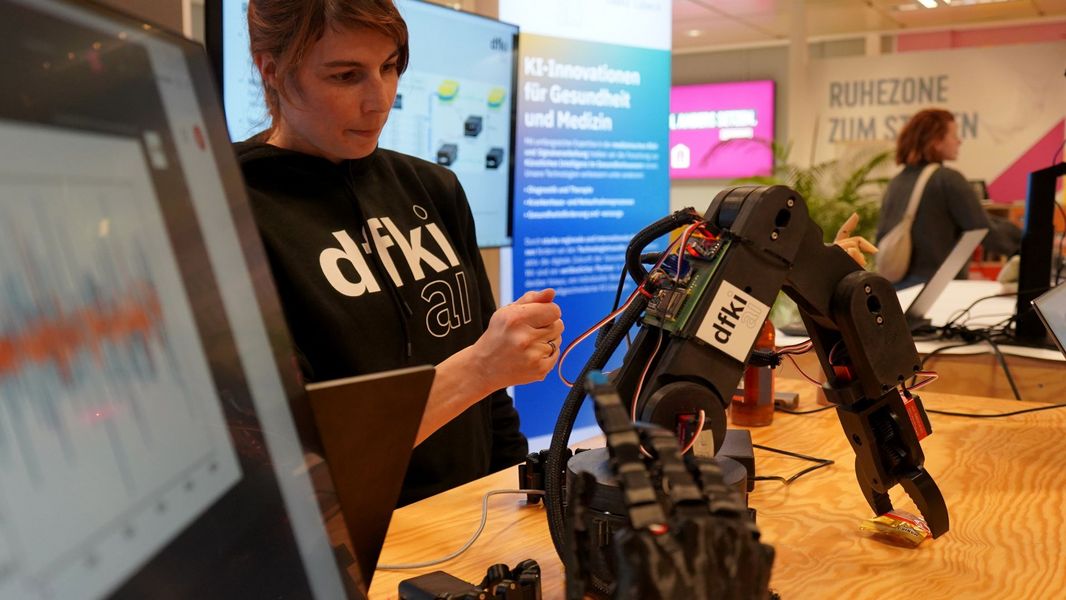 © DFKI, Swantje Schmidt
Lübeck AI Experience Day
Date and time
Tuesday, 10 November 2026, 9 a.m.–5 p.m.
Venue
Haerder Center
Königstraße 84–96, 23552 Lübeck, Germany
Admission
Free admission. No registration required.
DFKI at the Night of AI
At the Night of AI on 12 November 2026 at the Bauforum of Lübeck University of Applied Sciences, the DFKI, together with its project partner Splitbot, will present the CARE-Wise project. It is designed to support care staff in their day-to-day work using knowledge-based AI, for example with questions regarding medication schedules and internal care guidelines. To this end, the DFKI is investigating how information from care documents can be made specifically usable and how AI-generated pictograms can be employed for care instructions.
Further information
The full programme and further information on AI Week 2026 can be found at www.woche-der-ki.de.