
AI for Sustainable Ferry Transport: Award for Eco-Crossing Highlights the Potential of Data-Driven Solutions
| Environment & Energy | Autonomous Systems | Awards | Marine Perception | Osnabrück / Oldenburg | Press release

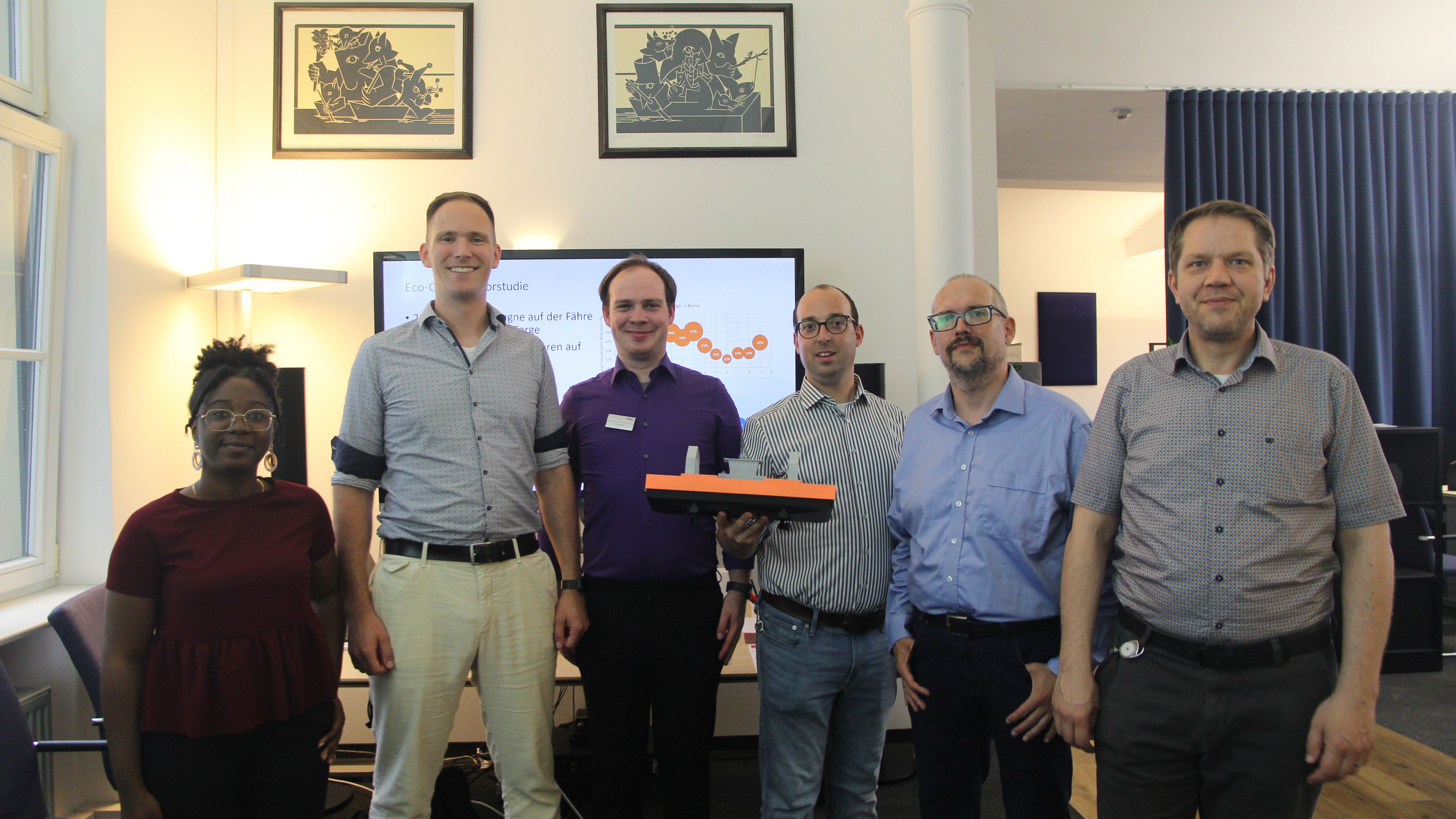
Together, Jade University of Applied Sciences, FBS – Fähren Bremen-Stedingen GmbH, and the German Research Center for Artificial Intelligence (DFKI) are developing an intelligent decision-support system for ferry operators. By combining weather, current, tidal, and operational data, the system calculates energy-efficient navigation strategies. Model calculations indicate potential savings of more than 20 percent in fuel consumption, as well as up to 159 tonnes of CO₂ emissions and approximately €30,000 in operating costs per ferry each year.
Beyond its specific application, Eco-Crossing reflects a broader trend that can be observed across many areas of applied AI. Intelligent data-driven methods are increasingly being used to optimize complex technical systems, including energy supply, water management, and environmental monitoring. In many cases, the real innovation lies less in new hardware than in the intelligent use of existing data.
This trend is also reflected in numerous DFKI research projects. They demonstrate how artificial intelligence can help operate existing infrastructures more sustainably, monitor environmental change more precisely, and manage complex systems more efficiently. An overview of selected projects can be found in the information box below.

The recognition of Eco-Crossing therefore extends beyond a single research project. It demonstrates the important role that artificial intelligence can play in making existing infrastructures more sustainable and illustrates how application-oriented research helps reconcile environmental and economic objectives.


Examples from DFKI Research on AI and Sustainability
AI-REEFSHIELD
Autonomous AI systems support the monitoring and protection of marine ecosystems.
HAI-x
Explainable AI improves the monitoring of inland waters and supports sustainable water management.
SOWEKI
AI intelligently links the water and energy sectors to optimize energy consumption in drinking water supply systems.
DFKI develops AI solutions for biodiversity, environmental monitoring, the circular economy, and sustainable applications in energy, industry, and resource management, among many other fields.
Contact:
Prof. Dr. Frederic Theodor Stahl
- Frederic_Theodor.Stahl@dfki.de
- Phone: +49 441 99833 4713
Felix Becker, M.Sc.
- Felix.Becker@dfki.de
- Phone: +49 441 99833 4726