
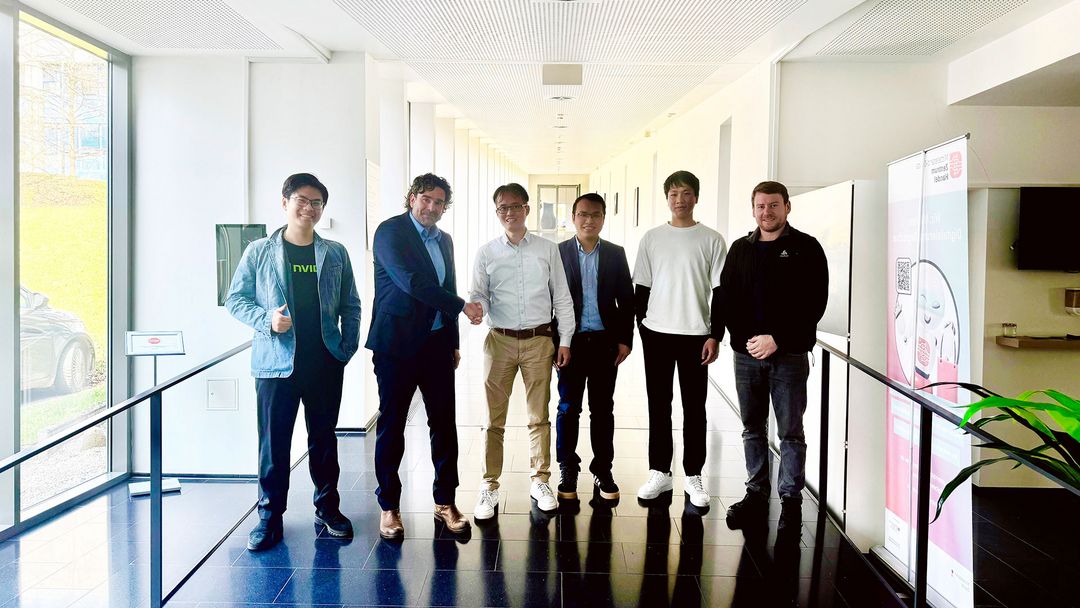
The discussions focused in particular on new robotic hardware platforms intended to support future research at IML. These systems will provide the foundation for cutting-edge research, especially within CORE IML in Oldenburg, where interactive AI systems are developed and demonstrated in close collaboration with partners. The planned collaboration could further strengthen research in the areas of physical AI and human-robot interaction, with the long-term perspective of developing fully autonomous intelligent systems.
Among the topics discussed were adaptive, explainable (XAI), and secure next-generation Vision-Language-Action (VLA) models designed for deployment in real-world environments. The participants also explored concrete application scenarios that are central to CORE IML, including multimodal human-robot interaction, interactive learning in real-world environments, and trustworthy AI systems for healthcare and assistive robotics.
Through the planned collaboration, IML further reinforces its strategic focus on combining machine learning and robotics, paving the way for impactful innovations at the intersection of AI and real-world systems. Both sides aim to further expand the partnership through joint projects and the development of shared research infrastructures.