
From exoskeletons for rehabilitation and space missions to connected emergency care: DFKI at MEDICA 2026
| Health & Medicine | Smart Home & Assisted Living | IT Security | Human-Machine Interaction | Robotics | Sensors & Networks | Intelligent Networks | Robotics Innovation Center | Kaiserslautern | Bremen
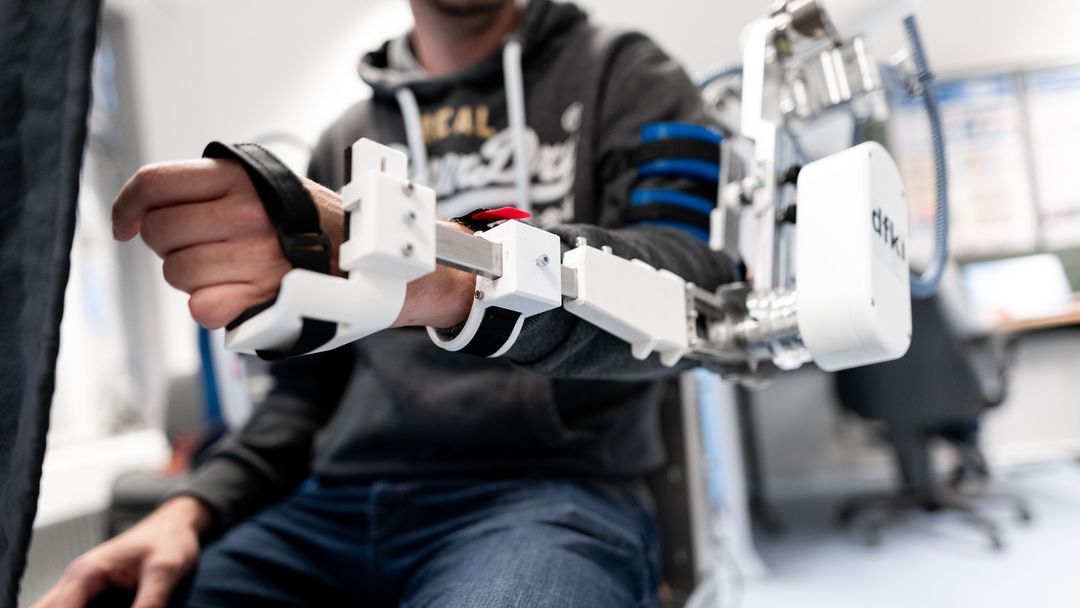
Hospital of the Future (Hall 12, Stand 13): Robotic assistance from rehabilitation to space
In the ‘Hospital of the Future’, an immersive hospital environment, visitors can experience technological developments across the entire care continuum: from acute care following a heart attack or accident through to rehabilitation and aftercare.
On the initiative of the INNOSPACE network ‘Space2Health’, the DFKI Robotics Innovation Centre, the DFKI project office AURA Lab Duisburg-Essen and the University of Duisburg-Essen are presenting three robotic demonstrators in the Aftercare & Homecare section: an exoskeleton for clinical use, an exoskeleton tested during parabolic flights in weightlessness, and an orthosis.
Using these demonstrators, the researchers are showing how robotic assistive technologies can be adapted to the individual abilities and needs of users. In stroke rehabilitation, for example, they can support targeted training of movement sequences and the recovery of motor skills. Furthermore, the researchers provide insights into potential applications of exoskeletons in space travel. These include the training of specific movement sequences under simulated and real weightless conditions, as well as the intuitive control of robots.
Presentation on the MEDICA Main Stage (Hall 12, Stand E36): How exoskeletons recognise human movement intentions
How can wearable robotic systems recognise human movement intentions even before a movement begins? In her presentation ‘Mind, Muscle, Machine: Intelligent Wearable Robots for Rehabilitation and Space’, Prof. Dr Elsa Kirchner from the University of Duisburg-Essen and the DFKI will present the latest research on AI-assisted exoskeletons on 19 November 2026 at 1.30 pm. The systems analyse neural and muscular signals to support movements, accelerate rehabilitation processes and enhance human performance in extreme environments.
Joint stand of the State of Rhineland-Palatinate (Hall 3, Stand E80): Secure data transmission and resilient networks for healthcare
Reliable digital healthcare requires secure data connections and resilient communication networks. This is the focus of the PATHCARE and SUSTAINET projects, which the DFKI Research Division for Intelligent Networks is presenting in collaboration with the Chair of Wireless Communication and Navigation (WICON) at RPTU Kaiserslautern-Landau at the Rhineland-Palatinate joint stand.
The PATHCARE project is dedicated to the reliable transmission of medical data. Among other things, it is researching so-called Wireless Body Area Networks (WBANs), which connect wearable sensors to medical systems. The aim is to reliably record, transmit and monitor vital signs and other sensor data, for example during emergency care at the scene and in the A&E department. In addition, the project is investigating 6G-based communication systems and AI-supported analysis methods.
The SUSTAINET project is a current CELTIC-NEXT flagship project involving more than 110 partners from eleven countries. It is developing high-performance, energy-efficient and fail-safe communication networks. These are designed to function reliably even in the event of technical faults, crises and cyber-attacks, thereby strengthening the resilience of critical infrastructure such as the healthcare sector.
In addition to the project presentations, Christoph Lipps from the DFKI’s Intelligent Networks research division will take part in the session ‘From Knowledge to Impact: How Rhineland-Palatinate is enabling healthcare innovation’ at the joint stand on Tuesday, 17 November 2026, at 3.00 pm.
DFKI discusses 6G at the MEDICA TECH FORUM (Hall 10, Stand G04)
Furthermore, on Thursday 19 November, from 1.05 pm to 1.20 pm, Christoph Lipps will speak at the MEDICA TECH FORUM on “6G-Health – High Performance 6G Networking for Distributed Medical Systems: A Holistic Approach”. Together with representatives from the VDE, Vodafone and the Innovation Centre for Computer-Assisted Surgery (ICCAS), he will discuss the potential of high-performance 6G networks for connecting medical systems, as well as issues relating to IT security and resilience in the healthcare sector as part of critical infrastructure.
DFKI at MEDICA 2026 – at a glance
Dates: 16–19 November 2026
Venue: Messe Düsseldorf
DFKI presentations:
- Hospital of the Future: Hall 12, Stand 13
- Joint stand of the State of Rhineland-Palatinate: Hall 3, Stand E80
Talks and programme items:
- 17 November, 3.00 pm: ‘From Knowledge to Impact: How Rhineland-Palatinate is making healthcare innovation possible’ – Rhineland-Palatinate joint stand
- 19 November, 1.30 pm: “Mind, Muscle, Machine: Intelligent Wearable Robots for Rehabilitation and Space” – MEDICA Main Stage, Hall 12, Stand E36
- 19 November, 1.05–1.20 pm: “6G-Health – High-Performance 6G Networking for Distributed Medical Systems: A Holistic Approach” – MEDICA TECH FORUM, Hall 10, Stand G04
Further information on MEDICA 2026: MEDICA 2026 – Official website
Contact:
Prof. Dr. Elsa Andrea Kirchner
- Elsa.Kirchner@dfki.de
- Phone: +49 421 17845 4113
Dipl.-Ges.Wirt (FH) Niels Will
- Niels.Will@dfki.de
- Phone: +49 421 17845 6660
Christoph Lipps, M.Sc.
- Christoph.Lipps@dfki.de
- Phone: +49 631 20575 5139