
DFKI Researchers Present More Than 20 Papers at EMNLP 2026
| Language & Text Understanding | Awards | Foundations of Systems AI | Interactive Machine Learning | Speech and Language Technology | Multilinguality and Language Technology | Saarbrücken | Berlin | Darmstadt | Osnabrück / Oldenburg
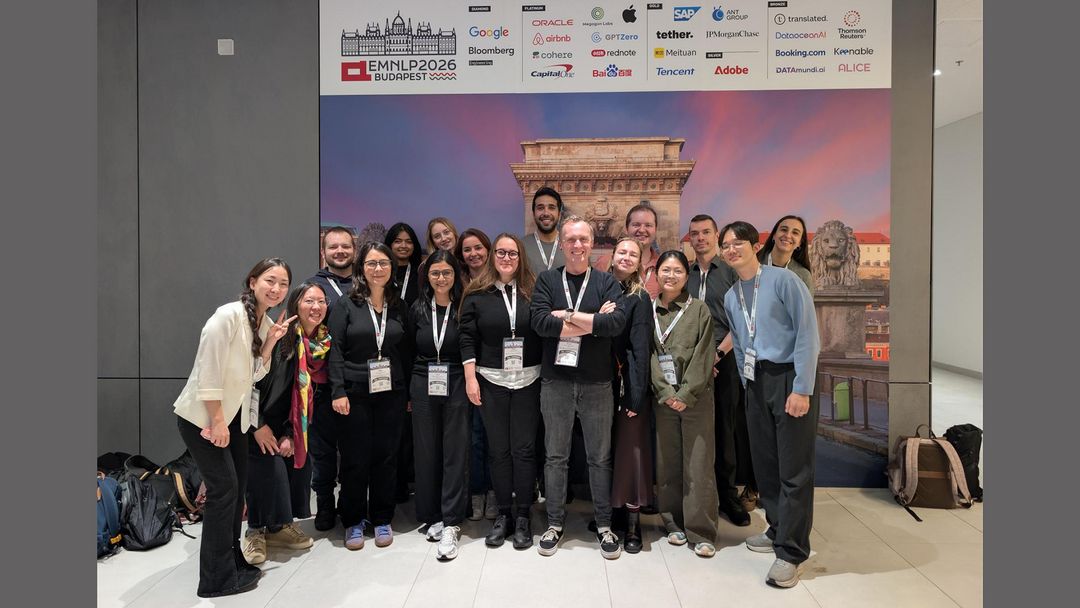
Organized annually by the Association for Computational Linguistics' Special Interest Group on Linguistic Data (SIGDAT), EMNLP is one of the world's leading conferences in natural language processing. DFKI contributed more than 20 papers across the main conference, findings, and workshop tracks. The contributions came from several research departments and partner groups, including Multilinguality and Language Technology (MLT), Speech and Language Technology (SLT), Interactive Machine Learning (IML), Foundations of Systems AI (SAINT), and the XplaiNLP group.
Advancing the Understanding of Language Models
A major focus of DFKI’s contributions was the growing effort to understand how large language models (LLMs) process information and generate outputs.
In one of the conference’s oral presentations, DFKI researchers argued that output tokenization does more than merely represent text. Their work suggests that tokenization serves as an implicit form of supervision and significantly shapes what language models ultimately learn.
Additional studies examined how models separate syntactic structure from language-specific information during translation, how they represent and select writing systems, and how activation steering techniques can combine multilingual and behavioral attributes. Researchers also demonstrated that steering methods can improve the generation of synthetic training data for low-resource languages.
Several other papers examined explainability and interpretability in language models, including the effects of model quantization on self-explanations, multilingual counterfactual explanations, the validity of automated explainability metrics, and the limitations of LLM-based simulators used to evaluate explanations.
Investigating Bias and Fairness
Another key research area addressed fairness and bias in language technologies. DFKI researchers analyzed how stereotypes are transferred from the internal representations of multilingual models into generated text. Other work showed that gender-related cues in prompts can affect both the quality of AI-generated code and how such outputs are evaluated.
Additional studies revealed systematic tendencies in how LLMs assess political claims and examined how methodological choices can influence the localization of demographic bias in clinical text generation. Together, these contributions underscore the importance of transparent evaluation methods and bias-aware model development.
New Perspectives on Evaluation and Data
A second oral presentation, featured in the conference’s special theme track, focused on evaluation practices in natural language generation research between 2020 and 2025.
Researchers also introduced FineWeb-CLaR, a resource that adds cultural, linguistic, and regional annotations to support the auditing of large-scale training corpora. Another contribution presented CHRONOBERG, a benchmark for studying language change and temporal awareness in foundation models.
Further work highlighted potential pitfalls in AI evaluation by showing that formatting artifacts can artificially improve the apparent performance of AI-generated text detectors.
A Wide Range of Applications
Beyond foundational research, DFKI's contributions demonstrated the practical application of NLP technologies across several domains. Research presented at EMNLP 2026 included privacy-preserving rewriting of clinical texts, investigations into factuality following domain-specific fine-tuning, length-controlled summarization using diffusion models, reinforcement-learning approaches to event extraction, and analyses of disinformation narratives and persuasive strategies in Ukrainian memes.
Building Trustworthy and Multilingual AI
A clear trend emerging from this year’s EMNLP is the growing importance of understanding how language models produce their outputs. As AI systems become more capable and widely deployed, interpretability, evaluation, and fairness are becoming central challenges for the research community.
DFKI’s contributions reflect this trend by integrating research on interpretability, multilinguality, evaluation, and real-world applications. Across projects and research groups, a shared goal remains: to develop language technologies that work reliably, transparently, and fairly across languages, cultures, and domains.
Contact:
Dr. Simon Ostermann
Deputy Head of RD Multilinguality and Language Technology, DFKI
- Simon.Ostermann@dfki.de
- Phone: +49 681 85775 5310