
Space Tech Expo Europe is one of Europe's leading trade fairs for space technologies. It brings together companies, research institutions and policymakers to discuss current developments and future prospects in the space sector. For DFKI, the exhibition provides an important platform to showcase its expertise in autonomous, AI-enabled systems and modular robotics for space applications, and to strengthen collaboration with stakeholders from academia and industry.
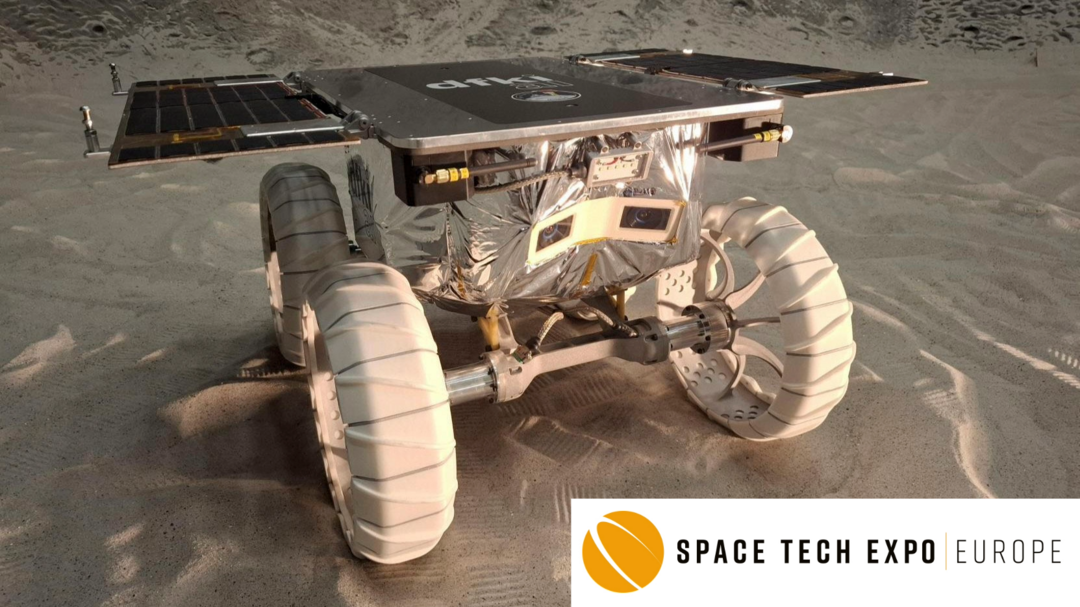
The DFKI Robotics Innovation Center's exhibition will focus on its research activities in the field of space robotics. Visitors can learn about the semi-autonomous micro-rover LuNiS, a platform for developing and testing technologies for use on the lunar surface under realistic conditions. One of the major challenges facing future lunar missions is the lunar night, which lasts around 14 days. Extreme temperatures and the absence of sunlight make it particularly difficult to keep robotic systems operational during this period. Using LuNiS, researchers are investigating concepts for power supply, thermal management and autonomy that could help rovers remain operational throughout this extended period of darkness.
In addition to ensuring the resilience of individual robotic systems, their ability to work together will also be crucial for future lunar missions. To support this, DFKI is developing intelligent interfaces and hybrid connection systems designed to enable different robotic systems to cooperate on the lunar surface. These technologies could lay the foundations for more complex robotic missions.
Beyond lunar exploration, DFKI is also researching autonomous robotic systems for in-orbit logistics. This includes technologies for satellite docking, refuelling and servicing. Such capabilities can help extend the operational lifetime of satellites, make more efficient use of resources and enable more sustainable operations in Earth orbit.
The research presented at Space Tech Expo Europe highlights the breadth of DFKI's work in space robotics: from exploring the lunar surface and enabling cooperation between autonomous robotic systems to carrying out servicing and logistics tasks in Earth orbit.
Further information: