RESILIA – Building a Resilient Society Through Artificial Intelligence and Resilience Labs
| Learning & Education | Cognitive Social Simulation | Press release
Our society often only reacts to crises after they have already occurred. Yet even minor disruptions, such as supply problems or a lack of information, can have major consequences. A purely reactive approach is therefore no longer sufficient. What is needed are new approaches that strengthen preparedness, cooperation and the ability to take action even before an emergency arises, and make these tangible.
RESILIA lays the foundations for effective and coordinated action in complex crisis and threat situations by bringing together all relevant stakeholders in realistic training, learning and testing environments. These include members of the public, public authorities, organisations with security responsibilities such as the fire service, THW and the German Red Cross, as well as units of the German Armed Forces. The aim is to develop a shared understanding of roles, capabilities, procedures and mutual expectations in the event of a crisis.
As part of the RESILIA project, a new innovation hub is being established, comprising a stationary, a mobile and a digital resilience laboratory. Together, they form a networked demonstration and testing environment in which realistic crisis scenarios can be simulated, response skills practised and cooperation between the public, emergency services and decision-makers tested in a practical setting. Members of the public can take part in exercises alongside civil protection stakeholders, thereby developing a better understanding of emergency preparedness and crisis management.
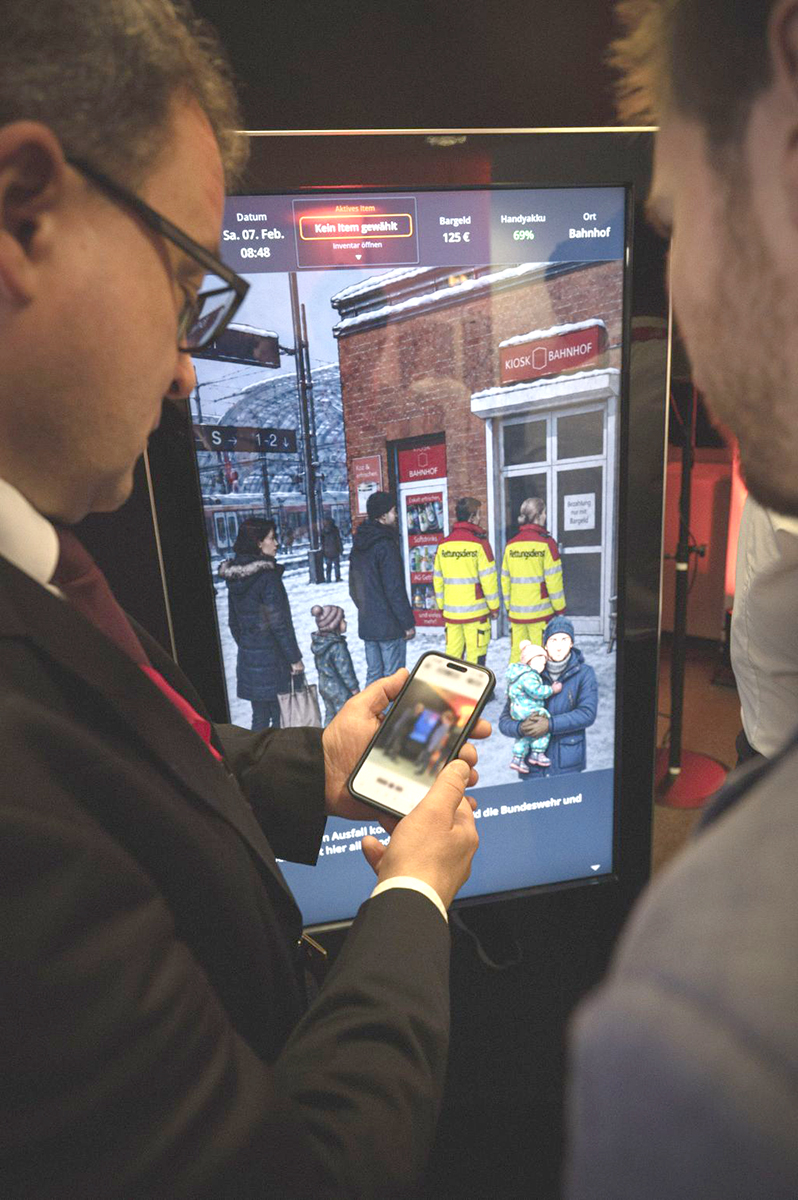
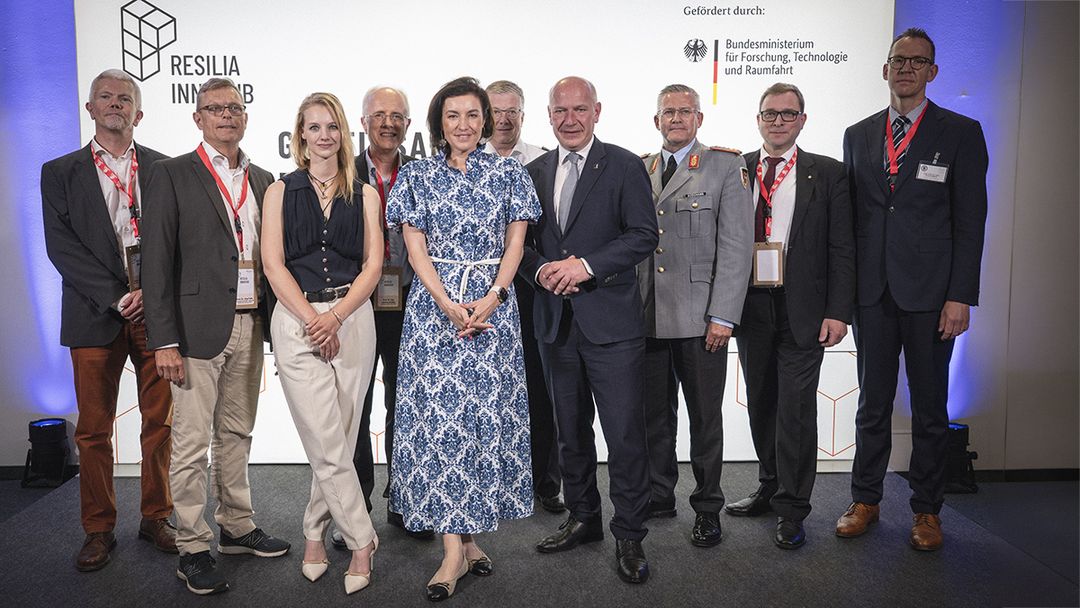
The stationary laboratory serves as a practical testing and learning environment featuring interactive formats such as escape games, in which participants must work together to overcome simulated scenarios such as a power cut or a cyberattack. The Resilience Lab at Berlin’s Ostbahnhof was officially opened on 27 May 2026 by Dorothee Bär, Federal Minister for Research, Technology and Space, and will be available to book for interested members of the public from 2027.
The mobile laboratory brings these interactive formats to schools or events in a flexible manner and adapts them to local conditions.
The digital lab offers virtual platforms with AI-supported, adaptive scenarios for location-independent training and learning. In this context, 'adaptive' means that simulation scenarios respond dynamically to the participants’ decisions and behaviour, enabling realistic and personalised learning experiences.
“RESILIA enables us to conduct interdisciplinary research into the human factor in networked laboratories and to make it possible to simulate and experience this in crisis management. With RESILIA, we combine distributed AI and cognitive social simulation in an adaptive digital twin, which, as an interactive serious game, allows users to experience crisis management first-hand and has the potential to serve as an interdisciplinary research infrastructure.”
The DFKI is playing a key role in developing the digital twin for the Resilience Lab infrastructure, which links the various learning and training environments together. Using distributed AI, cognitive social simulation and intelligent analyses of human decision-making processes, complex crisis situations are modelled and brought to life in interactive serious games.
Through the scientifically sound simulation of crisis scenarios, different stakeholders can test their behaviour, decision-making processes and collaboration under realistic conditions. The results are directly incorporated into the further development of training formats, tools and recommendations for civil protection. In this way, the DFKI is making an important contribution to preparing for future crisis situations.
The Berlin Fire Brigade is responsible for coordinating the consortium. Other partners include the DFKI in Trier, the Akademie der Katastrophenforschungsstelle gGmbH, the Free University of Berlin and the Helmut Schmidt University / University of the German Armed Forces in Hamburg. Together, they are developing innovative solutions that strengthen a culture of prevention, risk awareness and cooperation in complex crisis situations.
RESILIA is part of the ‘Innovation Hubs for Security and Defence’ initiative launched by the BMFTR. These hubs promote collaboration between civilian and military research and create practical demonstration and testing environments for innovative technologies and concepts. The Berlin Resilience Laboratory marked the opening of the first innovation hub of its kind. The project is funded by the Federal Ministry of Research, Technology and Space (BMFTR) via the project management organisation VDI/VDE from the approved special fund. The project will run until 31 December 2029.
Contact:
Prof. Dr.-Ing. Ingo Timm
- Ingo.Timm@dfki.de
- Phone: +49 651 462912 2800
Alexander Schewerda, M.Sc.
- Alexander.Schewerda@dfki.de
- Phone: +49 651 462912 8133
David Kaub, M.Sc.
- David.Kaub@dfki.de
- Phone: +49 651 462912 8129
Press contact:
Communications & Media Kaiserslautern | Darmstadt | Trier