
DFKI Coordinates European Research Project VICTOR-XR for Consistent Virtual and Real Worlds
| Health & Medicine | Industry 4.0 | Machine Learning & Deep Learning | Robotics | Language & Text Understanding | Virtual & Augmented Reality | Augmented Vision | Kaiserslautern | Press release
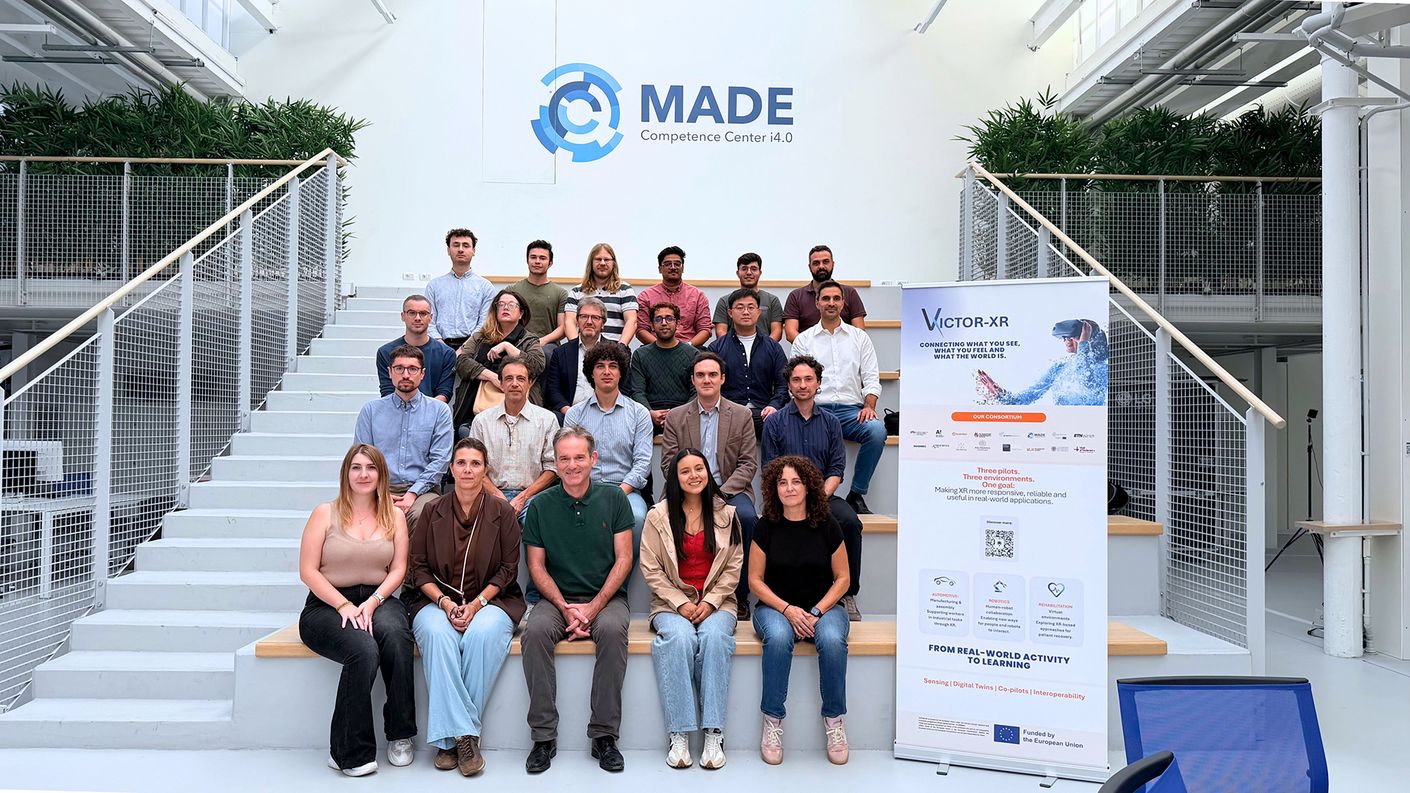 © EIT Manufacturing South / VICTOR-XR Consortium
The project will run through May 31, 2029, and brings together 16 partners from seven European countries, including leading research institutions, industrial companies, healthcare facilities, and innovative deep-tech companies. Together, they are developing a European reference framework for VPC, thereby laying the groundwork for secure, interoperable, and highly immersive applications in fields such as industrial manufacturing, collaborative robotics, and rehabilitation.
A Bridge Between the Physical and Virtual Worlds
A Bridge Between the Physical and Virtual Worlds
Virtual worlds and extended reality (XR) technologies are becoming increasingly important for industrial applications, education, healthcare, and collaborative work. To ensure that digital environments can reliably interact with real-world processes in the future, VICTOR-XR is developing a technological foundation for continuous synchronization between the real and virtual worlds.
“With VICTOR-XR, we are laying the groundwork for virtual worlds that not only map physical reality but also remain continuously connected to it. This opens up new possibilities for secure, efficient, and trustworthy XR applications in industry and healthcare,” says Prof. Didier Stricker, project coordinator of VICTOR-XR and head of the Augmented Reality Research Department at DFKI.
Innovative Architecture for Immersive XR Applications
The VICTOR-XR platform connects digital twins with real-time data from the physical world, enables multimodal interactions via speech, eye tracking, haptics, and biosignals, and provides intelligent assistance functions for users. In addition, the project is developing interoperable XR infrastructures, new learning and training approaches, and methods to ensure that data protection, security, and inclusion are built in from the start.
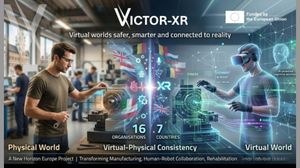 © EIT Manufacturing South / VICTOR-XR Consortium
Demonstrators in Industry and Healthcare
The technologies developed are being tested in three demanding application areas:
- Automotive production
- Collaborative robotics in industrial manufacturing
- Rehabilitation and healthcare
The goal is to demonstrate improvements in the synchronization between real and virtual environments. Measurable progress is expected in immersion quality, workplace safety, productivity, ergonomics, and clinical outcomes in the healthcare sector.
Strengthening the European XR Ecosystem
VICTOR-XR is firmly committed to open standards and actively contributes to European and international standardization. This is intended to ensure the reliability, robustness, and interoperability of future virtual world and XR solutions. The project thus makes an important contribution to the development of a competitive European ecosystem for virtual worlds and immersive technologies.
VICTOR-XR is funded by the European Union’s Horizon Europe research and innovation program under Grant Agreement Number 101298864.
Background: Greater Immersion Through Virtual-Physical Consistency
- Closed ground-update loop for continuously synchronizing digital twins with real-time sensor data from the physical world.
- Multimodal interaction systems that combine haptics, speech, image processing, eye tracking, and biosignals to significantly enhance immersion.
- Context-aware cognitive co-pilots that analyze environmental data and derive transparent and safe assistance functions from it.
- Standards-compliant middleware that ensures interoperability and interchangeability between XR systems.
- XR-native learning and assessment methods that translate operational data into measurable competencies and qualifications.
- A consistent “Ethics-by-Design” approach that integrates data protection, IT security, inclusion, and user well-being from the very beginning
Partners:
DFKI (Coordinator), Aalto University, Brembo, De Montfort University, ETH Zürich, EIT Manufacturing South, GraphicsVision.ai, MADE – Competence Center Industry 4.0, Masmec S.p.A., Neurofai GmbH, Neuranics Limited, Politecnico di Milano, Scuola Superiore Sant’Anna, Universitat Jaume I, Universitat Politècnica de València (UPV), Vall d’Hebron Institute of Research (VHIR)
Further Information:
Website: victorxr.eu
LinkedIn: linkedin.com/company/135256989/
YouTube: @VICTOR-XR-project
Contact:
Prof. Dr. Didier Stricker
- Didier.Stricker@dfki.de
- Phone: +49 631 20575 3500
Eric Thil, M.A.
- Eric.Thil@dfki.de
- Phone: +49 631 20575 3540