
Space research in national and international collaboration
DFKI collaborates closely with leading national and international space agencies, research institutes, and major companies within the space industry. These partnerships allow us to tailor our research and development activities to the actual needs of the space industry. At the same time, new methods and systems can be tested in practice, and European standards for safety, transparency, and sustainability can be shaped from the outset.
Particularly noteworthy is our close cooperation with national agencies such as the German Aerospace Center (DLR) and European agencies such as the European Space Agency (ESA). A key part of this collaboration is ESA_Lab@DFKI, founded jointly by ESA and DFKI in Kaiserslautern, which benefits from its proximity to the European Space Operations Centre (ESOC) in Darmstadt. ESOC manages mission control for 22 ESA spacecraft and the agency's space safety programme.
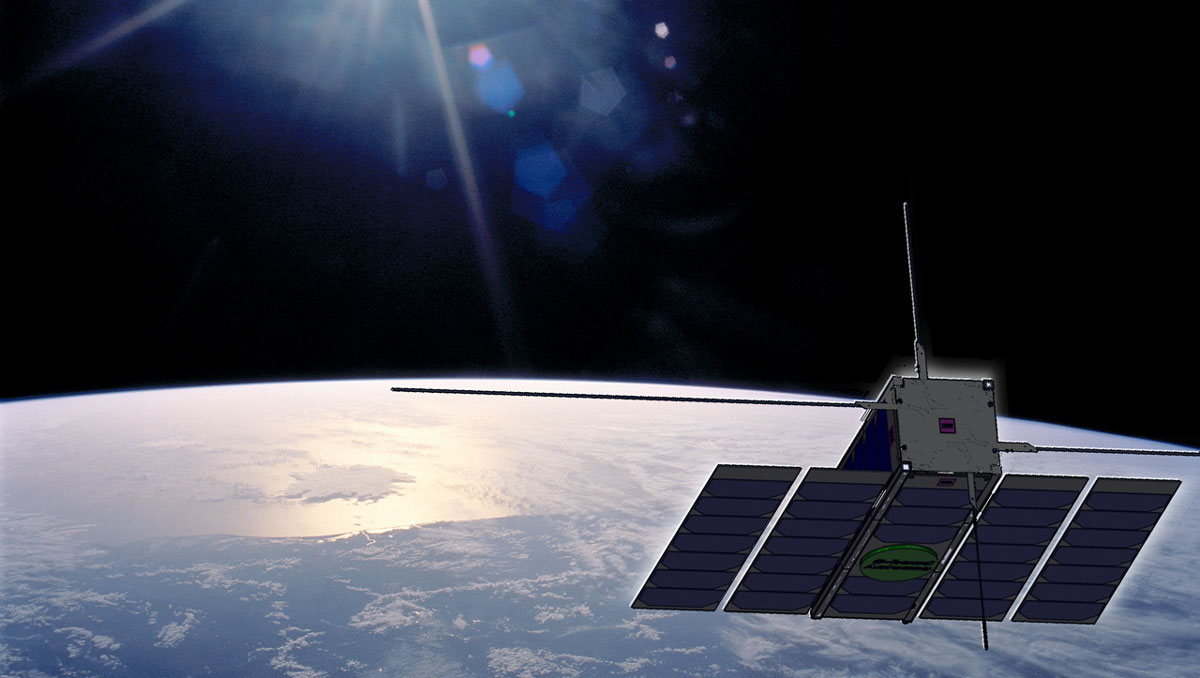
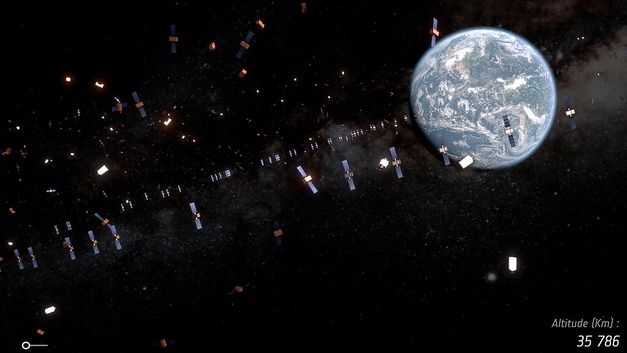
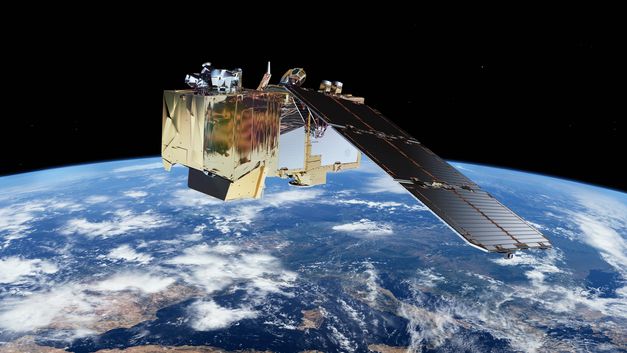
At ESA_Lab@DFKI, technologies for analysing complex satellite data and avoiding collisions in orbit are researched and developed further in collaboration with partners. This transfer lab is thus an example of DFKI's innovative strength in the international space sector.
ESA_Lab@DFKI – AI for space
 © ESA
© ESATo develop new AI technologies and applications for civil spaceflight, the European Space Agency (ESA) and the DFKI established the ESA_Lab@DFKI.
At the transfer lab in Kaiserslautern, researchers from both institutions work together on:
- AI systems for analyzing complex Earth observation data
- Solutions for satellite collision avoidance
This collaboration fosters a close exchange between research and practical space operations.
Further articles on space explorations
DFKI4Space

Unique research and testing infrastructure for space robots
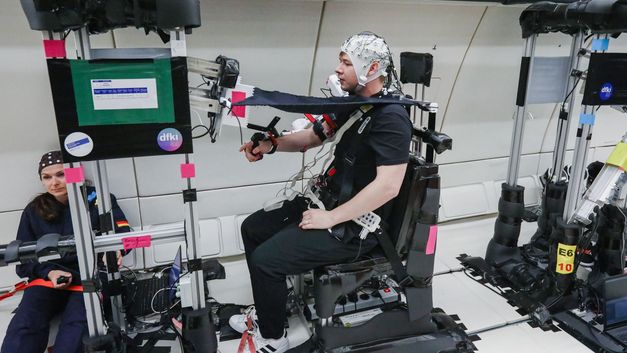
 © DFKI, Annemarie Popp
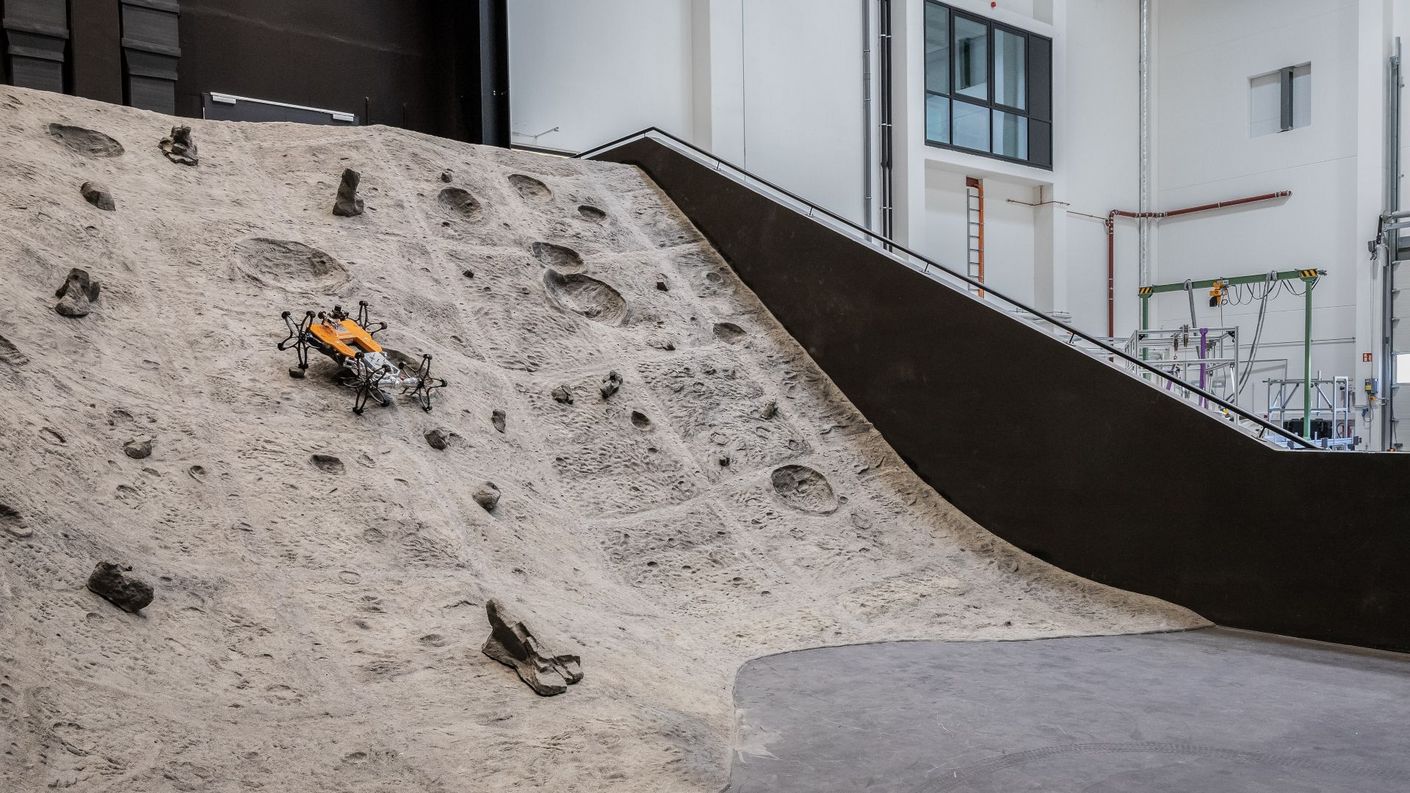
The Robotics Innovation Center in Bremen features a highly specialized research and testing infrastructure that enables the practical development and evaluation of robotic systems under realistic conditions. Systems, modules, and control units are tested iteratively to systematically increase their technology readiness and gradually adapt them to the requirements of planetary and orbital missions.
Test facilities:
- Crater landscape: Simulates Moon and Mars conditions, including slopes of up to 45°.
- Maritime Exploration Hall: Underwater and microgravity experiments with motion tracking.
- Virtual Reality Lab: Immersive environment for simulation, mission control, and teleoperation.
- ISO-compliant cleanroom: Hardware and electronics integration and quality control.
Field tests worldwide:
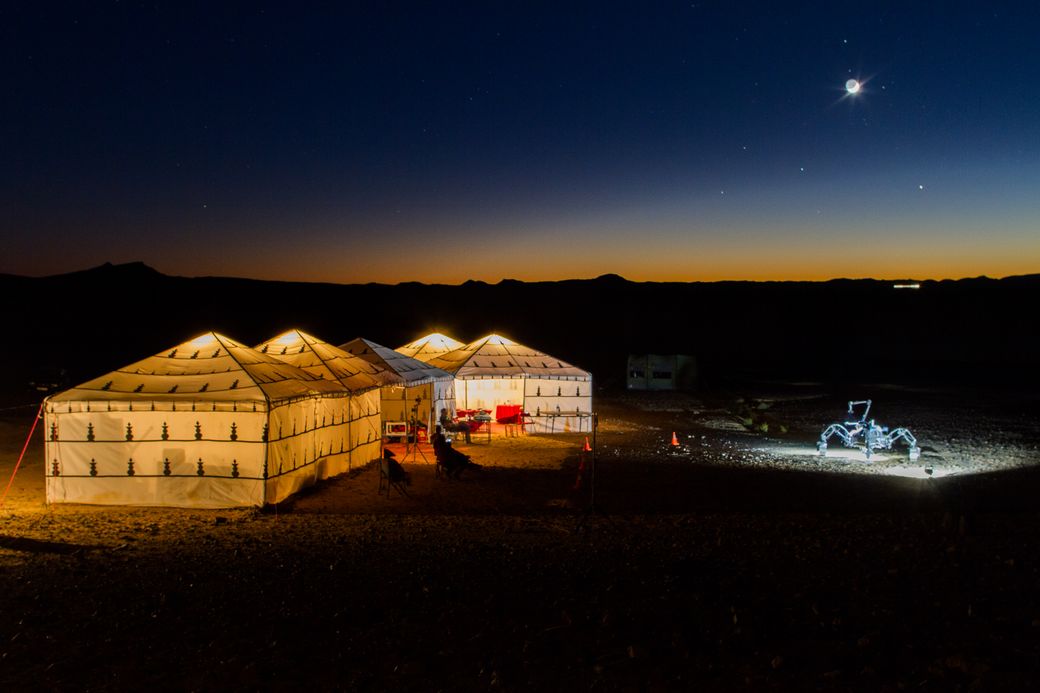
Testing under space-analog conditions on Earth, e.g., deserts, lava caves, or ice-covered waters.
ESA_Lab@DFKI – AI for space
© ESATo develop new AI technologies and applications for civil spaceflight, the European Space Agency (ESA) and the DFKI established the ESA_Lab@DFKI.
At the transfer lab in Kaiserslautern, researchers from both institutions work together on:
- AI systems for analyzing complex Earth observation data
- Solutions for satellite collision avoidance
This collaboration fosters a close exchange between research and practical space operations.