
DFKI presents its latest research in space robotics at the Joint i-SAIRAS & iSpaRo Conference 2026 in Cologne
| Robotics | Robotics Innovation Center | Bremen
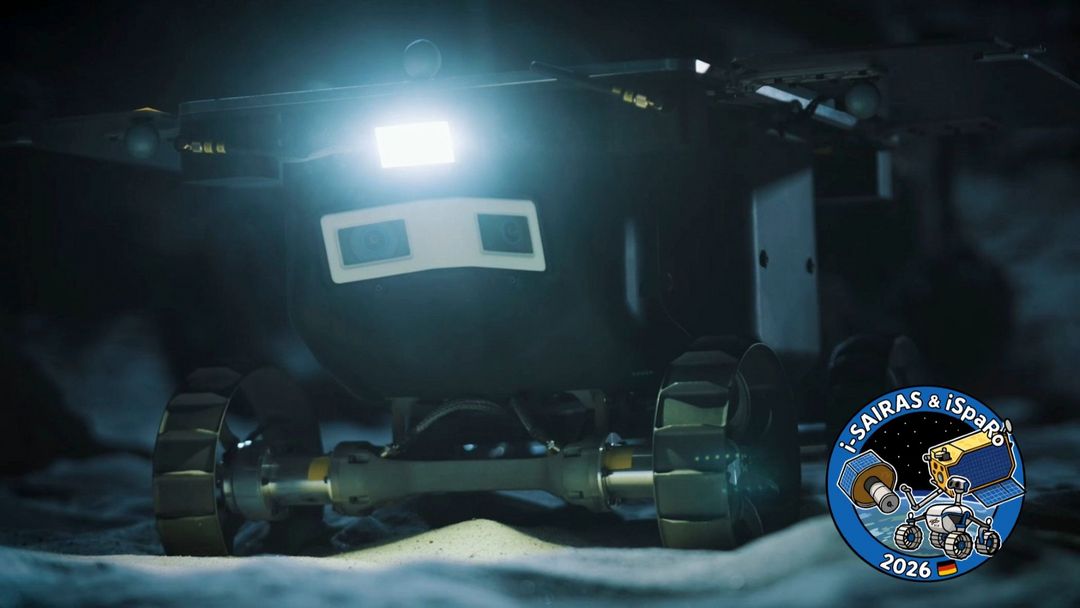
Robots designed for use on the Moon and other celestial bodies must operate under extreme conditions, adapt to unpredictable situations and perform complex tasks as autonomously as possible. The DFKI Robotics Innovation Center is developing technologies to help overcome these challenges in future space missions.
The Joint i-SAIRAS & iSpaRo Conference 2026 provides an international platform for the exchange of ideas and expertise. For the first time, the International Symposium on Artificial Intelligence, Robotics and Automation in Space (i-SAIRAS) and the International Conference on Space Robotics (iSpaRo) will be held jointly. From 3 to 6 November, experts from academia, industry and space agencies will discuss the latest research findings and future prospects for space robotics at the Confex in Cologne.
DFKI to showcase its research at its own stand
From 3 to 5 November, the DFKI Robotics Innovation Center will be exhibiting at Stand 25 at the accompanying trade exhibition, showcasing its activities in space robotics and its current research projects. A particular highlight is the semi-autonomous micro-rover LuNiS, which the researchers will demonstrate on site. It serves as a terrestrial test platform for testing technologies designed to withstand the approximately 14-day lunar night.
Workshop on multi-agent systems for space robotics
With the workshop “Multi-Agent Systems Strategies for Space”, the DFKI Robotics Innovation Center and the Robotics Research Group at the University of Bremen are also contributing to the conference’s technical programme. The aim is to promote the exchange of ideas and expertise on multi-agent systems in space robotics and to discuss the technologies required for their use in future missions.
When several robots carry out a mission together, they must exchange information, coordinate tasks and synchronise their actions. Such multi-agent systems open up new possibilities for exploration, maintenance and the construction of infrastructure in space, enabling far more complex missions than before. At the same time, they place high demands on communication, planning and autonomy. The workshop brings together researchers and practitioners to discuss current strategies and approaches to addressing these challenges.
In addition, DFKI researcher Wiebke Brinkmann will participate as a panellist in the iSpaRo workshop “Enabling Modularity and Interoperability in Space Robotics”. The focus will be on another key topic for future space missions: modular robotic systems whose components can be flexibly combined and interconnected across system boundaries.
Scientific contributions on current challenges in space robotics
In addition to the exhibition stand, the workshop and the panel discussion, the DFKI Robotics Innovation Center will also be represented at the Joint i-SAIRAS & iSpaRo Conference 2026 with several papers, presentations and posters. The topics range from technologies for lunar missions and planetary exploration to robotic resource utilisation, modular and cooperative robotic systems, energy-efficient image processing and the use of exoskeletons for space applications.
Papers
i-SAIRAS
- Overview of Various Robotic Technologies for Potential Use in the Artemis Lunar Mission. Authors: Felix Glinka (DFKI), Niels Will (DFKI), Wiebke Brinkmann (DFKI), Raúl Domínguez (DFKI), Manuel Meder (DFKI), Daniel Kühn (DFKI)
iSpaRo
- Lessons Learned from the ESA ESRIC Space Resources Challenge 2025: Robotics and Excavation Subsystem of Team BREMEN. Authors: Mehmed Yüksel (DFKI), Zhongqian Zhao (DFKI), Andreas Bresser (DFKI), Raúl Domínguez (DFKI), Manuel Meder (DFKI), Amrita Suresh (Uni Bremen), Kunal Kulkarni (DLR), Svenja Falker (DLR), Paul Zabel (DLR), Frank Kirchner (Uni Bremen, DFKI)
- Hardware-Accelerated Instance Segmentation for Resource-Constrained Space Robotics with Criticality Analysis. Authors: Siddhant Shete (DFKI), Hilmi Dogu Kücüker (DFKI), Udo Frese (Uni Bremen, DFKI), Frank Kirchner (Uni Bremen, DFKI)
- Friction aware Sliding Locomotion Model Predictive Control for Robust Planetary Exploration. Authors: Lukas Rust (Uni Bremen), Shubham Vyas (DFKI), Frank Kirchner (Uni Bremen, DFKI)
- Robust Leveling Control for a Mobile Free-Floating Testbed. Authors: Jakob Middelberg (DFKI), Blanka Burchard (DFKI/Marum)
Presentations
i-SAIRAS
- Effect of Real Microgravity and Simulated Microgravity on the Electromyogram by Means of an Active Exoskeleton. Presentation: Marc Tabie (DFKI), Mathias Trampler (DFKI), Elsa Andrea Kirchner (DFKI, Uni Duisburg-Essen)
- Software Architecture Overview and Status of a Semi-Autonomous Lunar Rover: Lunis. Presentation: Hilmi Dogu Kücüker (DFKI), Felix Glinka (DFKI), Siddhant Shete (DFKI), Sven Timme (DFKI)
- Sustainable, Reconfigurable, Modular Robotic Approaches for Planetary Applications. Präsentation: N.N.
Poster presentations
- Modularity as a Design Principle for Resilient Space Robotic Systems: A Cross Project Comparison (iSpaRo-Workshop). Presentation: Mehmed Yüksel (DFKI), N.N.
- ASTRO – Situation-aware Task Negotiation for Reconfigurable RObot Teams (i-SAIRAS). Presentation: Amrita Suresh (Uni Bremen), Ayden Janssen (Uni Bremen)
Event details
Joint i-SAIRAS & iSpaRo Conference 2026
- Date: 3–6 November 2026
- Venue: Confex, Conference and Exhibition Centre, Cologne
- DFKI exhibition stand: Stand 25, 3–5 November
- Workshop: ‘Multi-Agent Systems Strategies for Space’, 5 November, 2.30–5.30 pm
Further information on the event: Joint i-SAIRAS & iSpaRo Conference 2026
Contact:
Dr.-Ing. Mehmed Yüksel
- Mehmed.Yueksel@dfki.de
- Phone: +49 421 17845 6604
Manuel Meder, M.Sc.
- Manuel.Meder@dfki.de
- Phone: +49 421 17845 6600